
WORK & LIFTING INJURIES · RETURN-TO-WORK PLAN · LOGANSPORT, IN
Return-to-Work Plan After a Back Injury: 5 Steps to Reduce Re-Injury
Most re-injuries happen because demands jump too fast. This five-step plan rebuilds capacity safely.
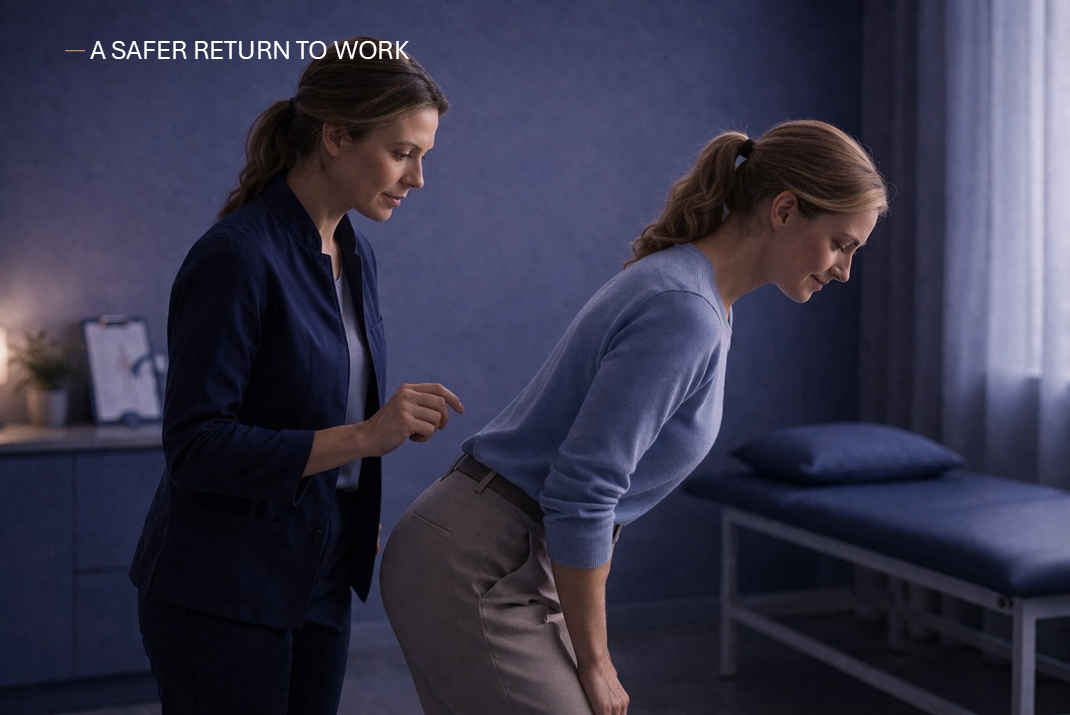
If your back flared at work—or you’re returning after an injury—the goal is not “perfectly pain-free” before you move. The goal is steady progress and stable next-day response. For the service overview, start with Work & Lifting Injuries. If your main issue is low back pain, see Low Back Pain Treatment.
- Simple plan you can follow without guessing
- Light duty rules that actually work
- Clear “when to worry” guidance
Educational only. Not medical advice. Seek urgent evaluation for severe/worsening symptoms or red flags.
Quick Start (Do This Today)
Use this to avoid the most common mistake: returning to full demand before your capacity is back.

The 3 rules (simple and reliable)
- Rule #1: You should feel the same or better the next day (mild soreness is okay).
- Rule #2: Avoid “spike” tasks for 7–14 days (heavy lifts, long carries, deep bends under load).
- Rule #3: Build tolerance in small steps—don’t test the painful movement repeatedly.
Green / Yellow / Red (self-check)
- Green: next day same/better → progress slightly.
- Yellow: mild soreness that settles within 24–48 hours → hold steady, don’t jump.
- Red: sharp spike, worsening leg symptoms, or loss of function → scale back and reassess.
The 5-Step Return-to-Work Plan
Each step has a goal, what to do, what to avoid, and the “pass marker” to move forward.
Calm the flare (48–72 hours)
Goal: reduce irritability and regain basic motion.
- Short walks, gentle range in safe directions
- Stop repeated “testing” of the painful bend/lift
- Use position changes (don’t stay in one posture too long)
Avoid: heavy lifts, long carries, deep bending under load.
Pass marker: pain spikes are less frequent and motion is less guarded.
Restore motion + confidence
Goal: move normally again in pain-safe ranges.
- Hip hinge practice (light, controlled)
- Gentle trunk endurance (short sets, frequent)
- Pick “green ranges” and build consistency
Avoid: end-range twisting under load.
Pass marker: you can hinge/squat lightly without fear or sharp spikes.
Rebuild capacity (strength)
Goal: increase tolerance so work demands don’t re-trigger symptoms.
- Glute/hip strength + hinge pattern
- Trunk endurance (carry/brace patterns)
- Progress volume before intensity
Avoid: “all-or-nothing” days (rest all day, then lift heavy once).
Pass marker: next-day response stays stable while workload increases.
Re-load job tasks (graded exposure)
Goal: safely return to your actual job demands.
- Practice: lift/carry/push/pull in controlled doses
- Increase reps/time before weight
- Use “block” strategy (tolerable work bouts + breaks)
Avoid: sudden return to full volume + speed.
Pass marker: you complete a shift with stable next-day symptoms.
Stay durable (maintenance)
Goal: keep capacity above your job demands.
- 2–3 short strength sessions/week
- Movement breaks on long shifts
- Keep a flare-up plan ready
Pass marker: symptoms no longer “run your week.”
If you’re not sure what you injured
Pattern clues help, but overlap is common. This guide can help you self-sort: Low Back Strain vs. Disc vs. SI Joint (How to Tell).
Progress Markers (What “On Track” Actually Looks Like)
If these are improving, you’re usually moving in the right direction—even if you still feel some symptoms.
- Sleep improves (less waking / easier positions)
- Less guarding and stiffness when you first get moving
- Better sit/stand tolerance
- Hinging feels safer and more controlled
- Carry tolerance improves
- Fewer “gotcha” spikes day-to-day
Imaging question?
If you’re not improving, imaging can be useful when it changes the plan. See: Do You Need Imaging for a Work Injury? A Clear MRI Decision Guide.
Light Duty Done Right (Where Most People Fail)
The goal is to reduce spikes while keeping you moving—then build tolerance back up.
Avoid these common traps
- Doing nothing all day, then a single heavy lift “test”
- One brutal task that spikes symptoms and resets the week
- Twisting under load because it’s “faster”
Better: the “block” strategy
- Work in tolerable blocks (e.g., 15–30 minutes) with brief resets
- Spread heavy tasks out (don’t stack them back-to-back)
- Keep loads close; pivot feet instead of twisting
Neutral, practical asks you can make
- Temporary cap on lift weight and carry distance
- More frequent micro-breaks for position changes
- Task rotation to avoid repeating the same bend/lift pattern
Simple Lifting Mechanics (Good Enough Wins)
You don’t need perfect form. You need a repeatable strategy that reduces spikes.
- Brace + hinge: hips back, load close, steady breath
- Load close: the farther it is, the harder your back works
- No twist while loaded: pivot feet instead
- Control the descent: most spikes happen lowering
If daily positions are your limiter, see: How to Sit, Sleep, and Lift with Low Back Pain (7-Day Plan).
Flare-Up Protocol (If You Spike Pain)
A calm reset plan that prevents the “panic spiral.”
First 24 hours
- Scale workload down (don’t re-test the painful movement repeatedly)
- Short walks + gentle range of motion
- Use comfortable positions; change posture frequently
Next 24–48 hours
- Return to Step 1–2 activities until next-day response stabilizes
- If leg symptoms are worsening or you’re losing function, get evaluated
When to Worry (Red Flags)
Get checked promptly if any of these are true.
- Progressive weakness (foot drop, worsening strength)
- Loss of bowel/bladder control or saddle numbness
- Fever with spinal pain or feeling very unwell
- Major trauma (fall, car accident)
- Rapidly worsening symptoms day-to-day
If you’re unsure, start with Contact & Location and we’ll guide you.
Return-to-Work FAQs
Quick answers—including “when to worry.”
Leave a Reply