Tag: Decision Guide

Comparison-style guides to help you choose the right next step (what’s normal vs not, what to try first, and when to get checked).

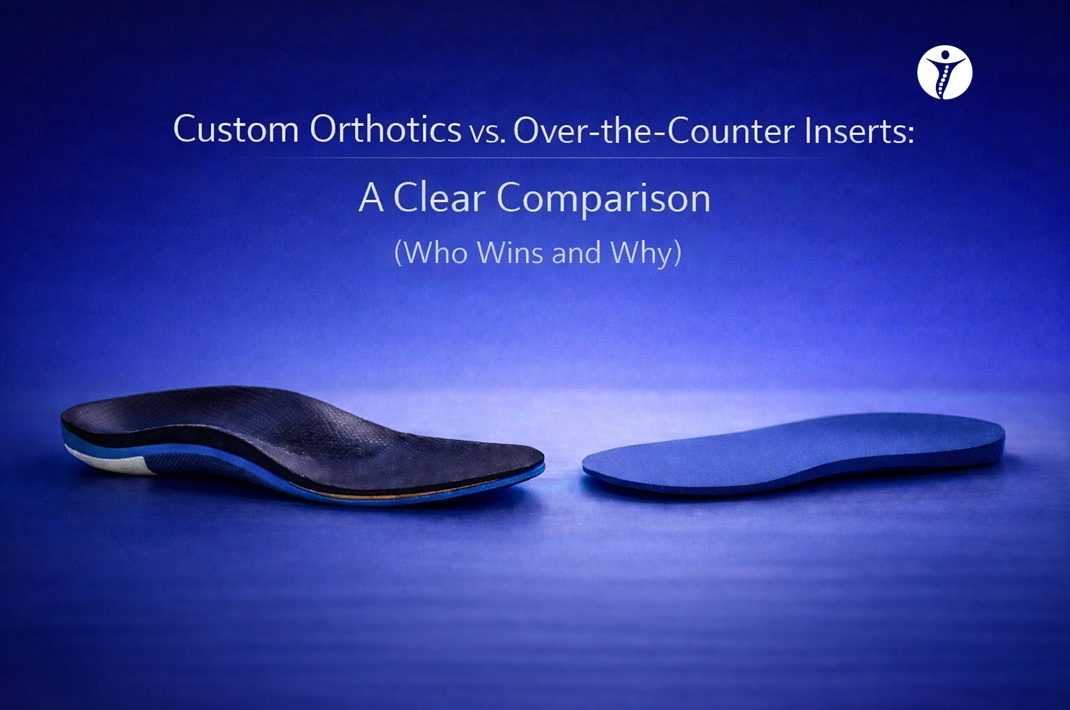
  • Custom Orthotics vs. Over-the-Counter Inserts: A Clear Comparison (Who Wins and Why)

    CUSTOM ORTHOTICS · FOOT & ANKLE PAIN · PATIENT EDUCATION · LOGANSPORT, IN

    Custom Orthotics vs. Over-the-Counter Inserts: A Clear Comparison (Who Wins and Why)

    The “best” choice depends on your pattern, your shoes, and your goals—not marketing.

    OTC inserts are often the best first step for mild-to-moderate symptoms
    Custom orthotics win when pain keeps coming back or mechanics are clearly driving overload
    The right shoe + break-in plan matters as much as the insert

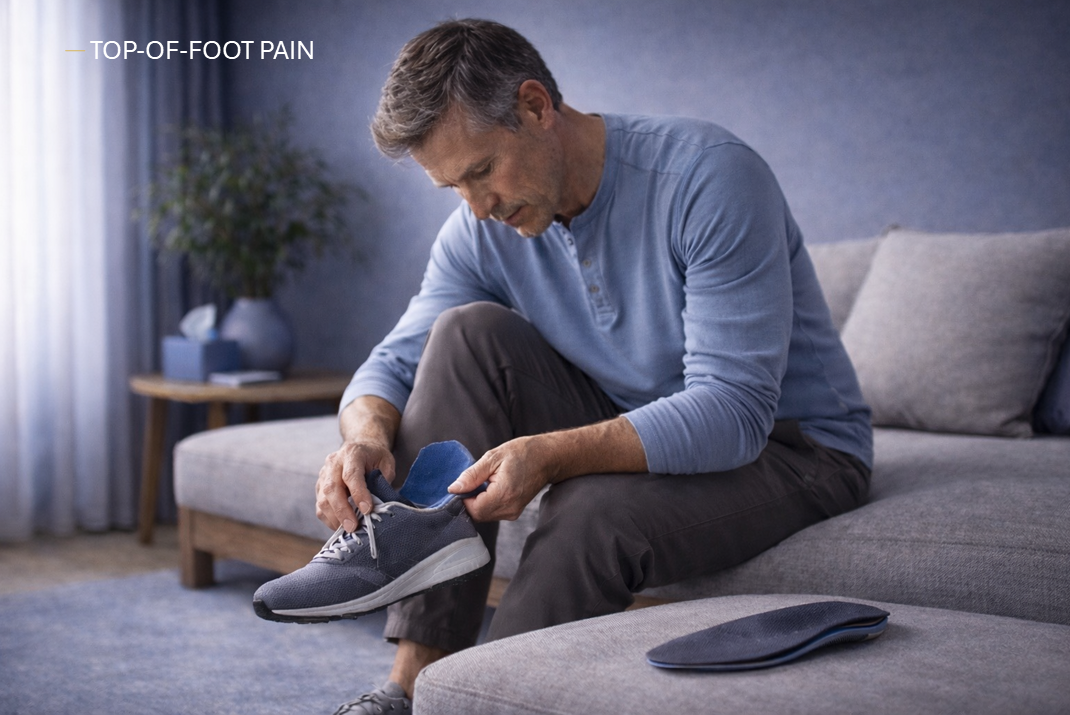
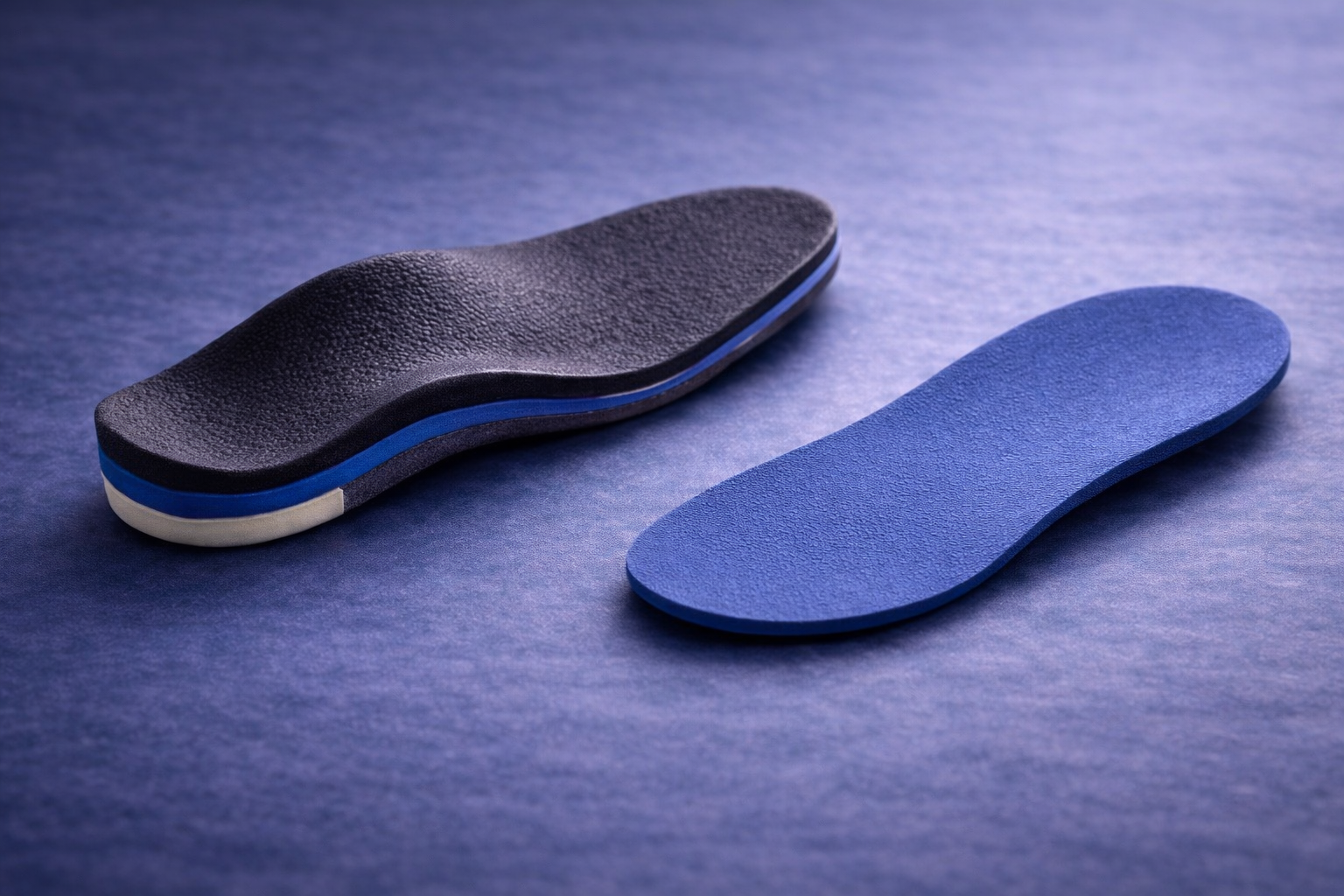
    If you’re trying to decide between custom orthotics and over-the-counter (OTC) inserts, here’s the honest truth: both can help—when they match the right problem. The goal isn’t “more expensive = better.” The goal is to reduce the driver (usually load + mechanics), then build durability with smart progression. If you’re dealing with recurring heel or arch pain, start with our Foot & Ankle Pain page or explore Custom Orthotics.

    • Choose the option that matches your pain pattern and activity demands
    • We use conservative care and clear expectations—no cookie-cutter plans
    • We’ll tell you honestly if OTC is enough for your case

    Educational only. Not medical advice. If symptoms are severe or rapidly worsening, seek urgent evaluation.

    Start Here: The “Big 4” Clues (Custom vs. OTC)

    These clues usually make the decision obvious.

    1) Is this your first attempt at support?
    If you haven’t tried a quality OTC insert and shoe change yet, that’s often the best, lowest-cost first step.
    First time trying support Mild to moderate symptoms Clear shoe trigger
    2) Does pain keep coming back?
    Recurring flare-ups after standing, walking, running, or work shifts often mean mechanics + load distribution are a key driver.
    Same spot, repeat flare-ups Worse with long days “I can’t trust my feet”
    3) Are you clearly asymmetric?
    One foot collapsing more, one knee caving in, one shoe wearing out faster, or one side always flaring = custom often wins.
    Uneven shoe wear One-sided pain “Crooked” mechanics
    4) Have you already tried good OTC—and still relapse?
    If you’ve done OTC + shoe changes + a smart break-in plan and symptoms still return, that’s when custom earns its keep.

    Fast rule

    If you have recurring flare-ups, clear asymmetry, or you’re on your feet for work/sport and need reliability, custom orthotics tend to outperform OTC—because they’re built to match your mechanics and shoes.

    Custom Orthotics vs. OTC Inserts: The Clear Comparison

    Here’s what matters (and what doesn’t).

    Category OTC Inserts Custom Orthotics Who “Wins”
    Best for Mild–moderate support, general comfort, first-step trials Recurring pain, clear overload patterns, asymmetry, high-demand work/sport Depends on the pattern
    Fit & precision Standard shapes (may match you well—or not) Built to match your foot mechanics and shoe demands Custom (when mechanics drive symptoms)
    Durability Varies; often shorter lifespan Typically more durable and predictable Custom
    Cost Lower Higher upfront OTC (for first step)
    How fast you feel it Sometimes immediate comfort if it matches you Often noticeable support; must be broken in correctly Tie (break-in matters)
    Most common mistake Buying “soft cushioning” with no support or wrong arch shape Skipping break-in, using the wrong shoe, or expecting a “magic fix” without strength/progression Avoidable with guidance

    What actually “wins” long-term

    The best outcomes come from support + shoe match + progressive strength. Inserts help manage load. Strength and smart progression keep you better. If your pain includes knee/hip/back stress, see our Low Back Pain page and we’ll help you connect the dots.

    Who Should Choose OTC Inserts?

    OTC is often the best first step when the pattern is simpler.

    OTC is a great choice if you…

    • Have mild-to-moderate foot fatigue or soreness
    • Notice pain mostly with one pair of shoes (shoe trigger)
    • Are trying support for the first time
    • Want a cost-effective trial before going custom

    Quick wins

    • Match the insert to your foot (arch shape + firmness), not just “soft” comfort
    • Pair with a supportive shoe (some shoes defeat even good inserts)
    • Use a gradual break-in plan (see Orthotics Break-In Schedule)

    Who Should Choose Custom Orthotics?

    Custom tends to win when you need reliability and repeatable relief.

    Custom is usually worth it if you…

    • Have pain that keeps returning (especially during long work shifts or training blocks)
    • Have clear mechanical overload patterns (collapsing arch, one-sided symptoms, uneven shoe wear)
    • Need support that’s consistent across your lifestyle (work shoes + athletic shoes)
    • Have already tried quality OTC inserts and still relapse
    • Want a plan that pairs orthotics with strength and progression (not just “wear these forever”)

    Where custom really shines

    • Repeatable results: built to your mechanics, not a generic mold
    • Better shoe matching: we choose the right profile for your footwear needs
    • Long-term plan: support now + durability later through strength and capacity

    Important note

    Orthotics aren’t a substitute for strength and smart progression. They’re a tool to reduce overload while your tissues rebuild capacity. If you want the full “candidate checklist,” see Custom Orthotics: 9 Signs You Need Them.

    Want a Clear Recommendation for Your Feet?

    We’ll evaluate your walking mechanics, shoe match, and activity demands—then tell you honestly whether OTC is enough or custom is the smarter move.

    Break-In: The Part People Skip (and Regret)

    Most “orthotics didn’t work” stories are really break-in, shoe match, or expectation problems.

    1

    Start slow

    Wear them for short periods first, then build up. Your body needs time to adapt to new support.

    2

    Match the shoe

    Some shoes defeat support. We’ll help you choose footwear that works with your insert, not against it.

    3

    Track the pattern

    Improving vs. stable vs. worsening? If you’re not trending better, adjust the plan early.

    Use this guide

    For a simple schedule and what’s normal vs. not, read: Orthotics Break-In Schedule: What’s Normal, What’s Not (and When to Call Us).

    When to Worry (Red Flags)

    If any of these are true, don’t just “try an insert.” Get checked promptly.

    • Can’t bear weight or a severe limp
    • Major swelling, bruising, deformity, or a clear injury mechanism
    • Pain that is worsening day-to-day (especially after an activity spike)
    • Escalating night pain, fever, or unexplained swelling
    • Numbness/tingling or burning that’s spreading

    Custom Orthotics vs. OTC Inserts FAQs

    Quick answers (and “when to worry”).

    Are custom orthotics always better than over-the-counter inserts?
    Not always. OTC inserts are often a great first step for mild-to-moderate symptoms or general support. Custom orthotics tend to make the biggest difference when symptoms keep returning, mechanics are clearly driving overload, or you’ve already tried good OTC options without lasting relief.
    What’s the best OTC insole for plantar fasciitis?
    A supportive insole that matches your arch shape and controls heel-to-forefoot load is usually the best starting point. If morning heel pain keeps returning, you’ll also want a plan that includes strength, walking-load management, and shoes. See Plantar Fasciitis: Morning Heel Pain Fixes.
    How do I know if I’m a good candidate for custom orthotics?
    Good candidates often have recurring flare-ups, clear overload patterns with standing/walking/running, visible wear-pattern asymmetry, and short-term improvement with support followed by relapse when support is removed.
    Can orthotics help knee, hip, or low back pain?
    Sometimes. If foot mechanics contribute to knee/hip/back stress, orthotics can reduce the driver. They work best paired with mobility/strength and a progressive return plan. See Low Back Pain or Hip Pain.
    How long does it take to get used to orthotics?
    Most people need a short break-in period. Start with limited wear time and build gradually. For a simple schedule, read Orthotics Break-In Schedule. If pain is sharp, worsening, or not trending better, get the fit and plan checked.
    When should I worry about foot pain instead of trying inserts?
    Get checked promptly if you can’t bear weight, have major swelling/bruising, pain that’s worsening day-to-day, escalating night pain, numbness/tingling, fever, or pain after a clear injury.
  • Cracking vs. Adjusting: What’s the Difference (and Why It Matters)

    CHIROPRACTIC ADJUSTMENTS · PATIENT EDUCATION · LOGANSPORT, IN

    Cracking vs. Adjusting: What’s the Difference (and Why It Matters)

    They can sound similar. The intent and safety process are not.

    Cracking is usually non-specific; adjustments are exam-guided and targeted
    Chasing “pops” can miss the real driver (posture, strength, load, nerve irritation)
    If you need to crack constantly, it’s a clue — not a solution

    If you’ve ever thought, “I just need to crack my back/neck,” you’re not alone. The key question is whether you’re getting temporary relief from a sensation, or actually addressing the reason you keep getting stiff and sore. This guide breaks down the real differences and the safest next step. If you want the full overview of what an adjustment is (and how we keep it safe), see Chiropractic Adjustment: What It Helps, What to Expect, and Safety.

    • We screen for red flags and choose technique based on your exam
    • We care about lasting change — not a sound
    • Clear “when to worry” guidance included below

    Educational only. Not medical advice.

    The Quick Answer

    Cracking is usually you chasing a sensation of relief. An adjustment is a specific, targeted input chosen after an exam, with safety screening and clear intent.

    Feature Cracking (self / “popping”) Chiropractic adjustment
    Goal Feels better / less pressure right now Restore targeted motion + reduce irritation safely
    Specificity Usually non-specific (whatever pops) Specific joint(s) based on exam findings
    Screening None History + exam; we look for red flags first
    Technique selection One approach (force/angle may vary) Technique matched to your body, comfort, and condition
    Best for Temporary stiffness sensation Mechanical pain patterns + a plan for lasting change
    Risk Higher if repeated, especially neck twisting Lower when exam-guided and appropriately selected

    Key point

    The sound (“crack”) is not the goal. The goal is improved motion, reduced sensitivity, and a plan that holds up between visits.

    Why the Difference Matters

    Here’s why “just cracking it” can keep you stuck in a loop.

    1) Cracking can mask the driver

    Many people crack because the area feels tight. But tightness can come from posture, stress, overuse, strength imbalance, or nerve irritation. Example: a desk worker with neck tension may need a posture + strength plan, not constant popping. See: Best Desk Setup for Neck Pain.

    2) You can become “pop dependent”

    If you feel like you need to crack multiple times per day, that’s a clue your system is irritated or you’re repeatedly exceeding tolerance. The fix is usually a better plan, not more cracking.

    3) Neck self-cracking is the one we’re most cautious about

    Repeated twisting and end-range neck manipulation is not something we recommend. If you have headaches, dizziness, arm tingling, or symptoms that feel “nerve-y,” get evaluated. See: Neck Pain with Arm Tingling: Pinched Nerve vs. Muscle.

    Want a Clear Answer (Not a Guess)?

    We’ll assess what’s driving your stiffness/pain, screen for red flags, and tell you exactly what makes sense. If adjustments are appropriate, we’ll choose the safest technique for you.

    How to Choose the Right Next Step

    Use these decision rules instead of guessing.

    If your symptoms are mostly stiffness

    • Occasional gentle movement + mobility may be enough
    • If stiffness keeps returning, look upstream: sleep, posture, workload, stress
    • Consider an exam if you’re “chasing pops” daily

    If your pain changes with posture or movement (mechanical pain)

    If symptoms travel down an arm/leg or feel nerve-y

    When to Worry (Red Flags)

    Skip cracking and get evaluated urgently if any of these are present.

    • Severe/worsening weakness in arm or leg
    • Loss of bowel/bladder control or saddle numbness
    • Fever with spinal pain
    • Major trauma (fall, car accident, injury)
    • Worst headache of your life, chest pain, or stroke-like symptoms

    If you’re unsure, start with Contact & Location and we’ll guide you.

    Cracking vs. Adjusting FAQs

    Quick answers—including “when to worry.”
    Is cracking your back the same as a chiropractic adjustment?
    No. Cracking is usually non-specific. An adjustment is targeted and chosen based on an exam with safety screening.
    Is the cracking sound bad?
    Usually not. The sound is often gas releasing in the joint. The sound isn’t required and isn’t the goal.
    Is it safe to crack your own neck?
    Repeated neck self-cracking isn’t recommended. If you feel you need to do it often, it’s smarter to get evaluated for the driver.
    Why does cracking feel good temporarily?
    It can temporarily change joint pressure and reduce the sensation of stiffness—but may not address posture, strength, load, or nerve irritation.
    When should I worry and seek urgent care?
    Urgent evaluation is needed for severe/worsening weakness, bowel/bladder changes, saddle numbness, fever with spinal pain, major trauma, chest pain, or the worst headache of your life.
    How do I know if I need an adjustment or something else?
    If symptoms are mechanical and there are no red flags, adjustments may help. If symptoms radiate, worsen, or feel nerve-y, an exam is the safest next step.

  • Do You Need Imaging for a Work Injury? A Clear MRI Decision Guide

    WORK & LIFTING INJURIES · PATIENT EDUCATION · LOGANSPORT, IN

    Do You Need Imaging for a Work Injury?

    A clear MRI decision guide—no fear tactics, no guesswork.

    After a work injury, it’s common to wonder: “Do I need an MRI?” The honest answer is—sometimes yes, often no. The key is knowing when imaging helps, when it doesn’t, and how to avoid unnecessary delays or procedures.

    • Most work injuries improve without advanced imaging
    • MRIs are tools—not answers by themselves
    • Red flags guide imaging decisions

    Why Imaging Isn’t Automatically the First Step

    Many work injuries involve muscle strain, joint irritation, or mechanical overload. These often respond well to appropriate conservative care without needing MRI.

    Studies consistently show that a large percentage of people without pain have disc bulges, degeneration, or “abnormalities” on imaging. That’s why we don’t order imaging based on pain alone.

    Instead, we look at:

    • How your symptoms started
    • What movements make them better or worse
    • Neurological findings (strength, reflexes, sensation)
    • Whether symptoms are improving, stable, or worsening

    If your symptoms fit a typical mechanical pattern, conservative care is usually the safest and fastest first step.

    Not Sure Which Category You’re In?

    A proper exam helps determine whether imaging is necessary—or whether conservative care is the smarter first move.

    When Imaging IS Appropriate After a Work Injury

    These situations typically justify MRI or further imaging.

    Progressive Neurological Symptoms

    Worsening weakness, numbness, or coordination issues—especially in the arms or legs.

    Pinched nerve evaluation →

    Bowel or Bladder Changes

    Loss of control or numbness in the groin/saddle region requires urgent evaluation.

    Severe Trauma

    Falls, crush injuries, or high-force accidents may require imaging early.

    Failure to Improve

    If symptoms don’t improve after a reasonable trial of care, imaging can guide next steps.

    Disc injury care →

    Common MRI Findings (and What They Really Mean)

    MRI reports often sound alarming—but context matters.

    • Disc bulge: Common and often painless
    • Degeneration: Normal age-related change for many adults
    • Herniation: May or may not correlate with symptoms

    Learn more about MRI language in our guide: Disc Herniation vs. Bulge vs. Degeneration

    MRI & Work Injury FAQs

    Quick, practical answers.

    • Do MRIs speed recovery? Not by themselves—treatment decisions do.
    • Can imaging delay care? Sometimes, especially if it’s ordered too early.
    • Is conservative care safe? Yes, when red flags are ruled out.

    Want the Right Answer—Not Just a Scan?

    We’ll help you determine whether imaging is necessary, what it would change, and how to move forward safely after a work injury.

  • Tech Neck Treatment: Ergonomics vs. Exercises vs. Chiropractic—What Works Best?

    POSTURE & TECH NECK · NECK PAIN RELIEF · LOGANSPORT, IN

    Tech Neck Treatment: Ergonomics vs. Exercises vs. Chiropractic—What Works Best?

    The best plan is the one that reduces your daily load and builds your capacity.

    “Tech neck” isn’t just posture—it’s time under tension. Hours of screen use, sustained positions, and repeated micro-stress add up until your neck and upper back feel stiff, sore, and sensitive. The good news: most people don’t need a complicated plan. You need the right sequence: reduce the trigger → restore motion → build strength → maintain.

    • Ergonomics reduces load (the cause)
    • Exercises build capacity (the solution that lasts)
    • Chiropractic helps restore motion—best when paired with both

    Tech Neck Isn’t “Bad Posture.” It’s Load.

    People get stuck because they try to “sit up straight” for two hours—and fail. The better question is: How can we reduce the total neck load across your day?

    Common tech neck patterns

    • Neck stiffness and ache after screens
    • Upper trap tightness and tension
    • Mid-back “stuck” feeling (especially with deep breaths or rotation)
    • Headaches that build late day
    • Occasional arm tingling (needs screening)

    Why it keeps coming back

    • Ergonomics improved briefly—but breaks are still missing
    • Exercises were random, not progressive
    • Strength and endurance never caught up to work demands
    • No plan for maintenance after symptoms calm down

    If your symptoms include headaches, also read: The “Headache Posture” Trap. If you feel arm tingling, see: Pinched Nerve vs. Muscle Tension.

    What Works Best: A Simple Decision Guide

    Most people need a combination. Here’s how to decide what to start with.

    Start with Ergonomics if…

    You’re flaring during workdays and symptoms correlate with screens and sitting.

    • Neck pain is mostly end-of-day
    • Better on weekends
    • Monitor is low / laptop heavy use
    Best Desk Setup for Neck Pain →

    Start with Exercises if…

    Ergonomics is “pretty good,” but your neck can’t tolerate normal life yet.

    • Frequent stiffness returns quickly
    • Posture feels hard to maintain
    • Upper back is tight/weak
    Tech Neck Fixes That Actually Work →

    Consider Chiropractic if…

    Stiffness is “stuck,” you can’t turn well, or headaches build from neck tension.

    • Upper back feels locked
    • Neck rotation is limited
    • Headaches or mid-back tightness are involved
    Chiropractic Adjustments →

    Want a Plan That Fits Your Workday?

    We’ll identify the driver, screen for red flags, and give you a realistic plan you can actually stick to.

    Quick Wins (That Actually Change Symptoms)

    Don’t overhaul your life. Make 3–4 high-impact tweaks and stack consistency.

    1) Raise the screen

    Top third of your monitor near eye level. Laptop? Add a stand + external keyboard/mouse.

    2) Break the “static” cycle

    Every 30–45 minutes: stand, reset posture, and take 6–10 deep breaths with upper-back expansion.

    3) Add one “capacity” drill

    Pick one simple exercise you can do daily (below). Consistency beats variety.

    4) Use your mid-back

    Many tech neck cases improve fastest when thoracic mobility and scapular control are restored.

    Mid Back Pain Relief →

    If you want the full workstation guide, use: Best Desk Setup for Neck Pain.

    A Simple 10-Minute Plan (No Equipment)

    This is not “random stretching.” This is a minimalist plan that targets the most common weak links.

    Daily (2–4 minutes)

    • Chin tucks: 2 sets of 8–10 reps (gentle, not forced)
    • Thoracic extension: 6–8 slow reps (over chair back or foam roller)
    • Neck “reset” breathing: 6–10 breaths, ribs down, shoulders relaxed

    3–4x/week (6–8 minutes)

    • Row / band pull-aparts: 2–3 sets of 10–15
    • Wall slides: 2 sets of 8–10
    • Isometric holds: gentle neck holds 10–20 seconds, 2–3 reps

    When to Worry (Red Flags)

    Most tech neck is mechanical—but these signs deserve prompt evaluation.

    • Progressive arm weakness (dropping items, worsening grip)
    • Worsening numbness/tingling down the arm
    • Severe pain after trauma (fall, car accident)
    • Fever, unexplained weight loss, or night pain that escalates
    • “Worst headache of my life” or sudden neurologic changes

    If you have arm symptoms, start here: Neck Pain with Arm Tingling. If headaches are involved, see: When to Worry About a Headache.

    Tech Neck FAQs

    Quick answers (and “when to worry”).

    What is the fastest fix for tech neck?
    The fastest wins usually come from reducing daily neck load: screen height/position, frequent movement breaks, and a few targeted mobility drills. If stiffness keeps returning or headaches/arm symptoms appear, an evaluation helps.
    Are exercises or ergonomics more important?
    Both matter. Ergonomics reduces the load that caused the problem; exercises increase your capacity so the same load bothers you less. Most people need both—ergonomics first, then progressive strength.
    Can chiropractic help tech neck?
    Often, yes—especially when joint stiffness and upper-back restriction contribute to neck tension. Chiropractic works best when paired with ergonomics and a simple strength plan so results last.
    Why does tech neck cause headaches?
    Sustained forward head posture increases tension in the upper neck and suboccipitals and can irritate joints that refer pain into the head. Many tension-type and neck-related headache patterns improve when mechanics and load are addressed.
    When should I worry and get checked urgently?
    Seek urgent evaluation for severe/worsening neurologic changes, major trauma, fever with severe neck pain, sudden worst headache of your life, or progressive arm weakness/numbness.
    How long does it take to improve tech neck?
    Many people notice improvement within 1–2 weeks when they reduce daily triggers and start the right exercises. Longer-standing patterns may take several weeks to rebuild strength and tolerance. Consistency matters more than intensity.

    Ready to Make Tech Neck a Non-Issue?

    We’ll identify your driver, restore motion, and give you a realistic plan you can actually maintain—so your neck stops paying for your screen time.

  • Runner’s Knee vs. Meniscus: How to Tell (and What to Do First)

    KNEE PAIN · SPORTS & ATHLETIC PERFORMANCE · LOGANSPORT, IN

    Runner’s Knee vs. Meniscus: How to Tell (and What to Do First)

    Two common knee problems. Very different “first steps.” Here’s the safe way to self-sort.

    “My knee hurts when I run” can mean a lot of things. The two most commonly confused problems are runner’s knee (patellofemoral pain) and a meniscus issue. The best next step depends on the pattern: where it hurts, what triggers it, and whether there are red flags like locking or swelling. This guide walks you through practical checks—then gives you a safe plan for what to do first.

    • Runner’s knee is often load + hip control + cadence/stride
    • Meniscus issues are more “joint-line + twist + swelling/locking” patterns
    • Not every meniscus tear needs surgery—but some patterns need evaluation

    Quick Sort: 4 Pattern Checks

    You’re not trying to self-diagnose perfectly—you’re trying to choose the safest next step. Look for the “best match.”

    1) Where does it hurt?

    • Around/behind the kneecap: more runner’s knee
    • Inner or outer joint line: more meniscus

    2) What triggers it most?

    • Stairs, hills, squats, long sitting: more runner’s knee
    • Twisting, pivoting, deep flexion + rotation: more meniscus

    3) Is there swelling?

    • Little/no swelling: often runner’s knee
    • Swelling after runs or next-day “puffiness”: more meniscus/irritation

    4) Does it catch or lock?

    • No catching/locking: often runner’s knee
    • Catching/locking, can’t fully straighten: evaluate for meniscus

    If stairs are the main trigger, also see: Knee Pain on Stairs: Why It Happens (and 5 Fixes).

    Want a Clear Answer for Your Knee?

    The fastest way to know what you’re dealing with is a thorough exam. We’ll explain what we find and give you a plan that matches your running and work demands.

    Runner’s Knee (Patellofemoral Pain): What It Usually Looks Like

    Runner’s knee is often an irritability + load management problem paired with hip control/strength and sometimes cadence/stride mechanics.

    Common clues

    • Dull ache around/behind kneecap
    • Worse with stairs, hills, squats, long sitting
    • Often shows up after a training spike (miles, hills, speed, new shoes)
    • Typically minimal swelling

    What to do first (2-week plan)

    • Reduce aggravators: hills, speed work, deep squats
    • Keep easy runs easy; shorten stride if pain spikes
    • Add hip + quad control (pain-free range)
    • Progress volume gradually as symptoms calm

    If running is your main trigger, review: Running Pain Checklist.

    Meniscus Pattern: What It Usually Looks Like

    Meniscus issues often involve joint-line pain and may flare with twisting, pivoting, or deep knee bending—especially if there was a clear “twist + pop” moment.

    Common clues

    • Pain at the inner or outer joint line
    • Swelling after activity (same day or next day)
    • Catching, locking, or “giving way” sensations
    • Sharp pain with twist/pivot or deep flexion

    What to do first

    • Avoid deep flexion + twisting early
    • Short-term load reduction (don’t “test it” daily)
    • Regain pain-free range + quad control first
    • Get evaluated if swelling/locking persists

    Not sure which side is driving mechanics? The knee often reflects hip/foot inputs too. If you have recurring lower-chain issues, consider reviewing Hip Pain or Foot & Ankle Pain.

    When to Worry (Red Flags)

    These patterns deserve prompt evaluation rather than “waiting it out.”

    • Locking (can’t fully straighten or bend the knee)
    • Significant swelling or swelling that keeps returning after activity
    • Instability/giving way that changes your gait
    • Pain that is worsening day-to-day despite reduced load
    • A clear injury with twist/pivot and a “pop,” especially with swelling

    If you’re unsure, the safest move is an exam: schedule here.

    FAQs: Runner’s Knee vs. Meniscus

    Quick answers—including when it’s time to get checked.

    What does runner’s knee usually feel like?
    Runner’s knee commonly feels like a dull ache around or behind the kneecap, worse with stairs, hills, squats, or long sitting. It’s often load-related and improves with training changes and hip/quad strength work.
    What does a meniscus injury usually feel like?
    Meniscus patterns often involve joint-line pain (inner or outer edge), swelling after activity, and sometimes catching/locking or sharp pain with twisting. Not every tear needs surgery, but red-flag patterns should be evaluated.
    Can I run with a meniscus tear?
    Sometimes—but it depends on symptoms. If there’s locking, significant swelling, instability, or worsening day-to-day pain, get evaluated before continuing. If symptoms are mild and stable, a guided load plan may be possible.
    When should I worry and get imaging?
    Get checked if your knee locks, you can’t fully straighten it, swelling is significant or recurrent, you can’t bear weight normally, pain is worsening daily, or the injury involved a clear twist/pop. Imaging may be appropriate depending on the exam.
    What should I do first for runner’s knee?
    Reduce irritability first: scale back hills/speed/deep squats, keep easy runs easy, and start hip + quad control work in a pain-free range. Most cases improve with a few focused changes and gradual progression.
    What’s the fastest way to calm knee pain on stairs?
    Reduce aggravating load briefly, prioritize pain-free strength work, and improve hip control. If stairs remain sharply painful or swelling/locking appears, get evaluated.

    Want a Runner-Specific Knee Plan?

    We’ll identify the most likely driver, reduce irritability, and build a return-to-running progression you can trust.

  • Hip Pain vs. Sciatica vs. Low Back Pain: How to Tell (and What to Do First)

    HIP PAIN · DECISION GUIDE · LOGANSPORT, IN

    Hip Pain vs. Sciatica vs. Low Back Pain: How to Tell (and What to Do First)

    Same area. Different drivers. Different “first step.”

    If you’re not sure whether your pain is the hip joint, the tendons around it, or nerve irritation from the back, this guide helps you narrow the most likely bucket.

    • Simple pattern checks
    • What to do first (safe steps)
    • Clear red flags

    Want a Straight Answer?

    We’ll check hip range of motion, strength, gait, and low-back/nerve signs—then explain what’s driving your symptoms.

    Quick Pattern Checks

    Not a diagnosis—just a practical way to narrow the likely driver.

    1

    Hip joint–leaning pattern

    Clues: deep groin pain, stiffness after sitting, limited rotation, pain with deep flexion.

    First step: mobility + joint-friendly strength + movement modification.

    2

    Outer-hip tendon / “bursitis” pattern

    Clues: outer hip tenderness, worse with side sleeping, stairs, standing on one leg.

    First step: reduce compressive positions + progressive glute strengthening.

    3

    Back / sciatic referral pattern

    Clues: leg symptoms (tingling/numbness), pain changes with back position, traveling pain.

    First step: calm irritation, protect aggravating movements, evaluate nerve signs.

    See: Sciatica Treatment in Logansport, IN →

    When to Worry

    Seek urgent evaluation for rapidly worsening weakness, loss of bowel/bladder control, inability to bear weight after injury, fever, or severe unrelenting pain.

    Let’s Identify the Driver—Then Fix It

    We’ll give you a clear explanation and a plan that fits your body and goals.

  • Rotator Cuff vs. Impingement vs. Frozen Shoulder: How to Tell (and What to Do First)

    SHOULDER PAIN · DECISION GUIDE · LOGANSPORT, IN

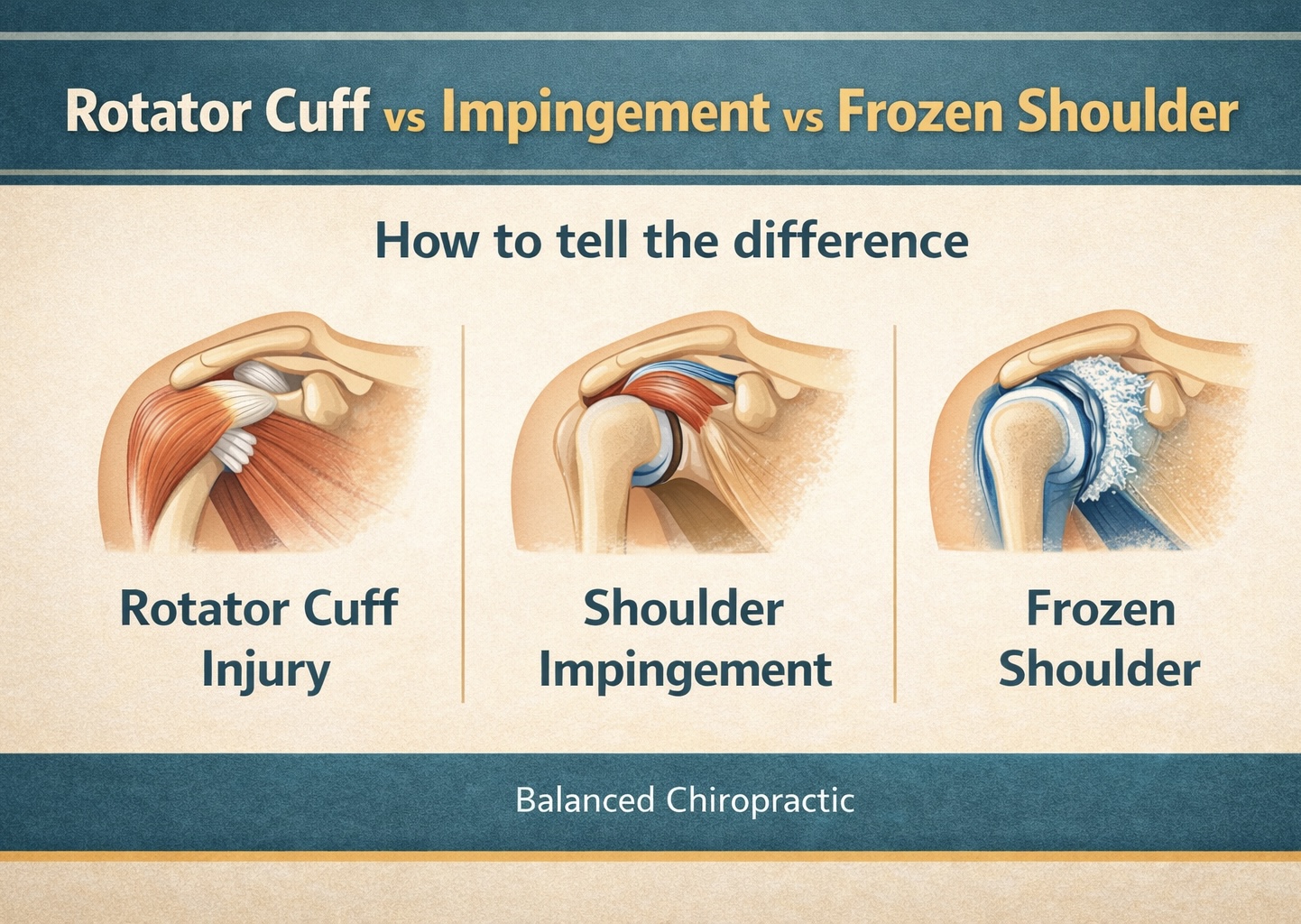
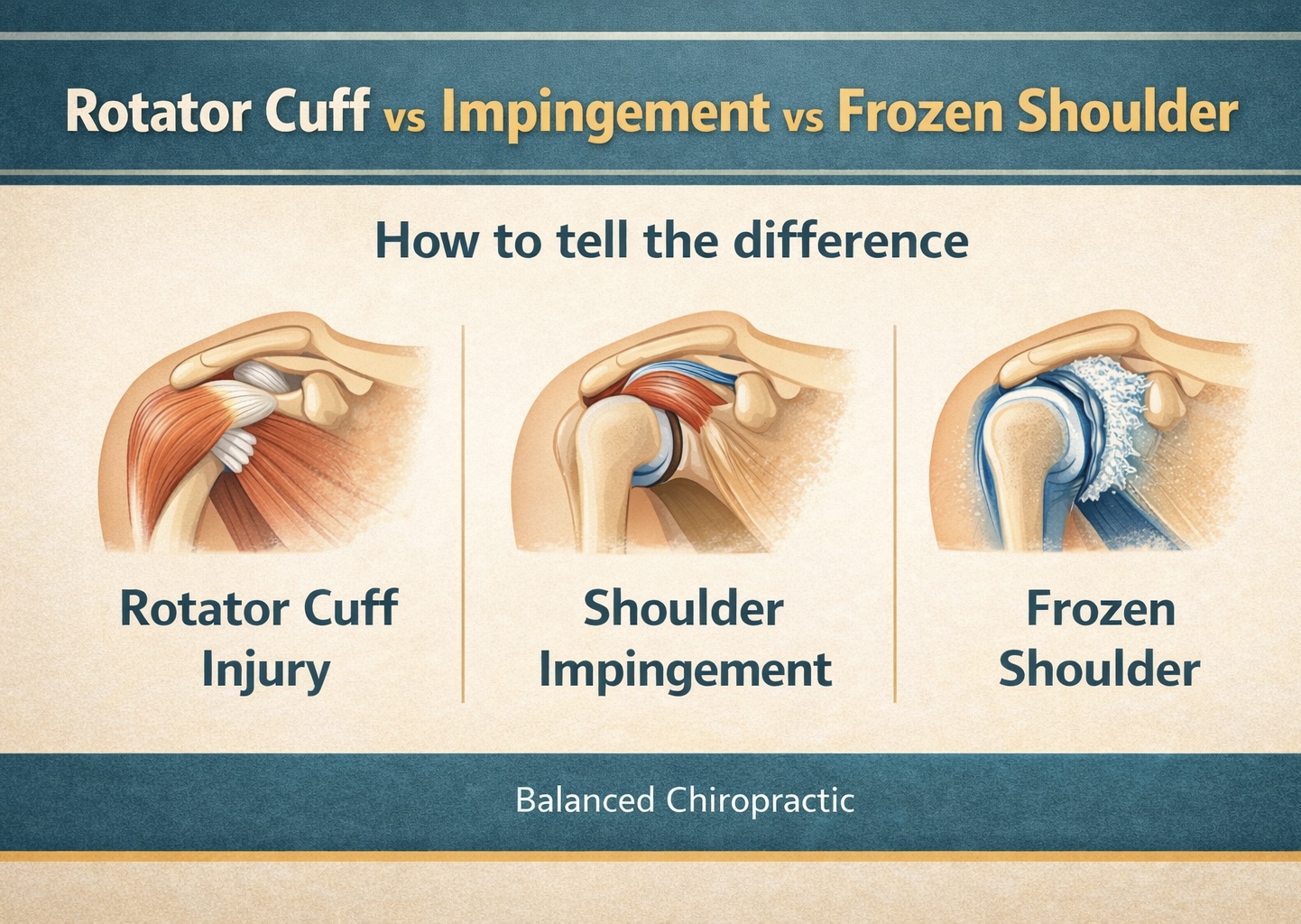
    Rotator Cuff vs. Impingement vs. Frozen Shoulder: How to Tell (and What to Do First)

    These three are commonly confused — but the best “first step” differs.

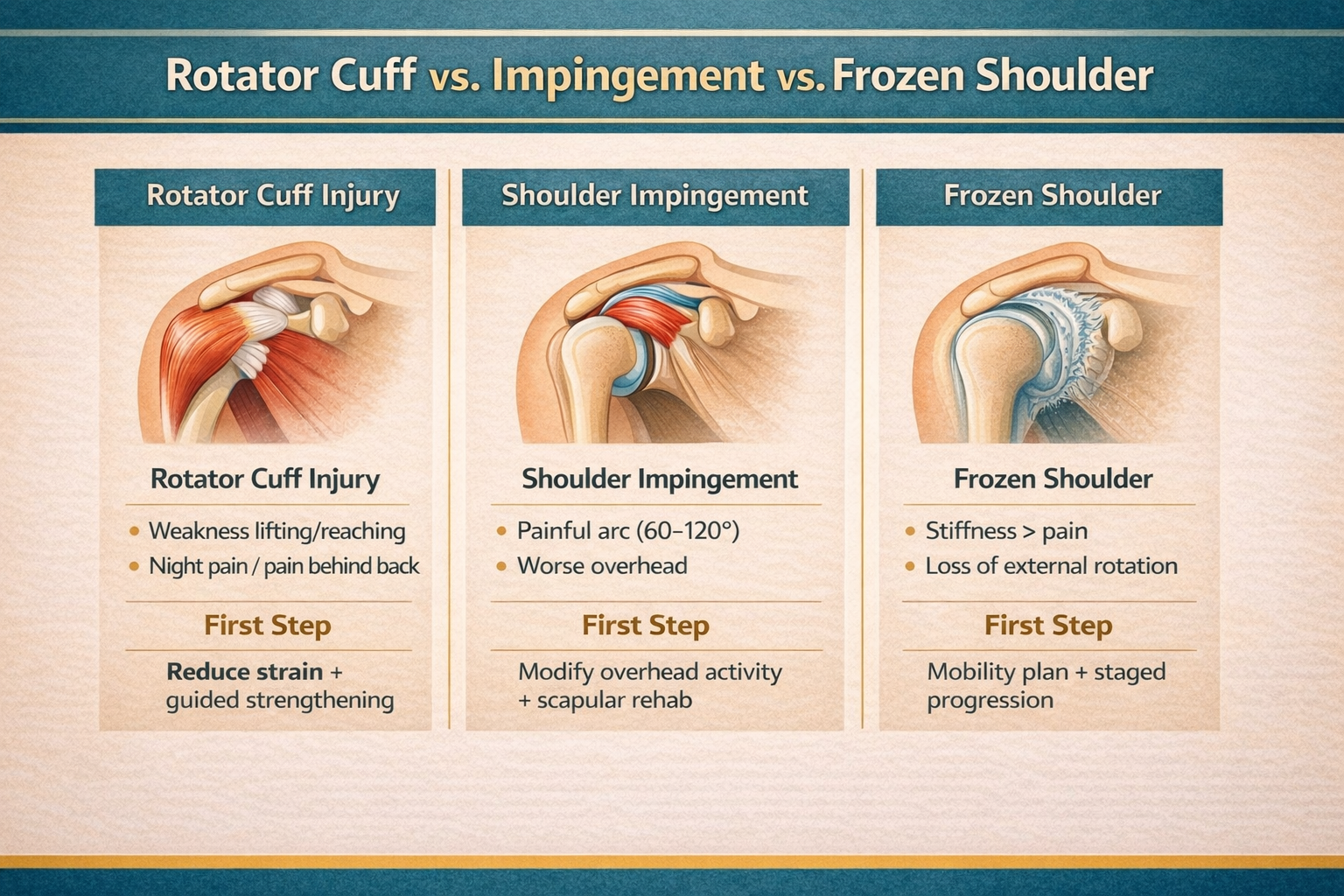
    If you’ve been told “it’s probably your rotator cuff,” you’re not alone. Here are practical pattern checks to help you understand what’s most likely — and what to do first.

    • Simple pattern checks
    • First-step plan for each scenario
    • Clear red flags

    Want a Clear Answer Fast?

    We’ll test range of motion, strength, and shoulder blade mechanics to pinpoint the driver and guide your plan.

    Quick Pattern Checks

    Not a diagnosis—just a way to narrow the most likely bucket.

    1

    Frozen Shoulder (stiff + blocked)

    Key sign: your shoulder feels “stuck,” especially rotating outward. Pain may be present, but stiffness is dominant.

    First step: staged mobility (not aggressive stretching) + a plan that respects tissue irritability.

    2

    Impingement-Type Pain (painful arc)

    Key sign: pain during part of the lift (often 60–120°), worse with repeated overhead work.

    First step: improve scapular mechanics + mobility + gradual strengthening.

    3

    Rotator Cuff Irritation (tendon overload)

    Key sign: pain/weakness with lifting away from the body and lowering the arm; night pain is common.

    First step: load management + specific tendon strengthening and technique cleanup.

    When to Worry

    Seek urgent evaluation for deformity after injury, inability to lift the arm, sudden severe swelling, fever, chest pain/shortness of breath, or new numbness/weakness down the arm.

    Get Clarity and a Plan That Fits

    We’ll confirm what’s driving your symptoms and build a step-by-step path forward.

  • Rib Pain vs. Mid Back Pain: How to Tell the Difference (and What to Do First)

    MID BACK PAIN · DECISION GUIDE · LOGANSPORT, IN

    Rib Pain vs. Mid Back Pain: How to Tell the Difference (and What to Do First)

    One-sided “mid back pain” is often rib-related — and the fix is different.

    Rib joint irritation, thoracic stiffness, and muscle strain can feel similar at first. Use the patterns below to narrow it down and choose the right first step.

    • Quick pattern checks
    • First-step plan (48–72 hours)
    • Clear “when to worry” guidance

    Not Sure Which One You Have?

    We’ll test the rib cage, thoracic spine, and surrounding tissue to find the true driver—then build a plan that fits.

    The 3 Most Common Patterns

    These are the “big three” we see behind rib/mid-back pain complaints.

    1

    Rib joint irritation (near the spine)

    Often sharp, one-sided, and can flare with deep breaths or twisting. Pain may feel “deep” rather than surface-level.

    2

    Intercostal / mid-back muscle strain

    Typically tender to touch and clearly aggravated by specific movements. Often follows a lift, twist, cough, or workout.

    3

    Thoracic stiffness + posture overload

    Dull ache between shoulder blades that worsens after desk work. If screens are part of your day, also see: Posture & Tech Neck →

    What to Do First (48–72 Hours)

    • Avoid the one motion that reliably spikes pain (temporarily).
    • Take short walks and gentle thoracic mobility (don’t force cracks).
    • Use heat 10–15 minutes to calm protective muscle guarding.
    • If work or lifting is the trigger, consider a technique reset: Work & Lifting Injuries →

    When to Worry

    Get urgent medical evaluation for chest pressure, shortness of breath, fever, cough with blood, fainting, severe constant pain, or if you feel significantly unwell.

    Next Step

    If your pain is persistent, worsening, or keeps returning, an exam saves time and prevents guesswork.

    Get a Clear Diagnosis (Not a Guess)

    We’ll identify whether your ribs, thoracic spine, or muscles are the main driver—and build a plan around that.