Category: Foot & Ankle Pain

Foot and ankle pain education—plantar fasciitis, ankle sprains, tendon irritation, footwear support, and when orthotics or further evaluation makes sense.

  • Top of Foot Pain in Logansport, IN: 6 Common Causes (and When to Worry)

    Top of Foot Pain in Logansport, IN: 6 Common Causes (and When to Worry)

    FOOT PAIN · PILLAR GUIDE · LOGANSPORT, IN

    Evidence-informed, conservative care We assess foot + ankle + gait + footwear Clear “when to worry” guidance

    Top of Foot Pain in Logansport, IN: 6 Common Causes (and When to Worry)

    Top-of-foot pain often follows a pattern. Use the clues below to choose the right first step.

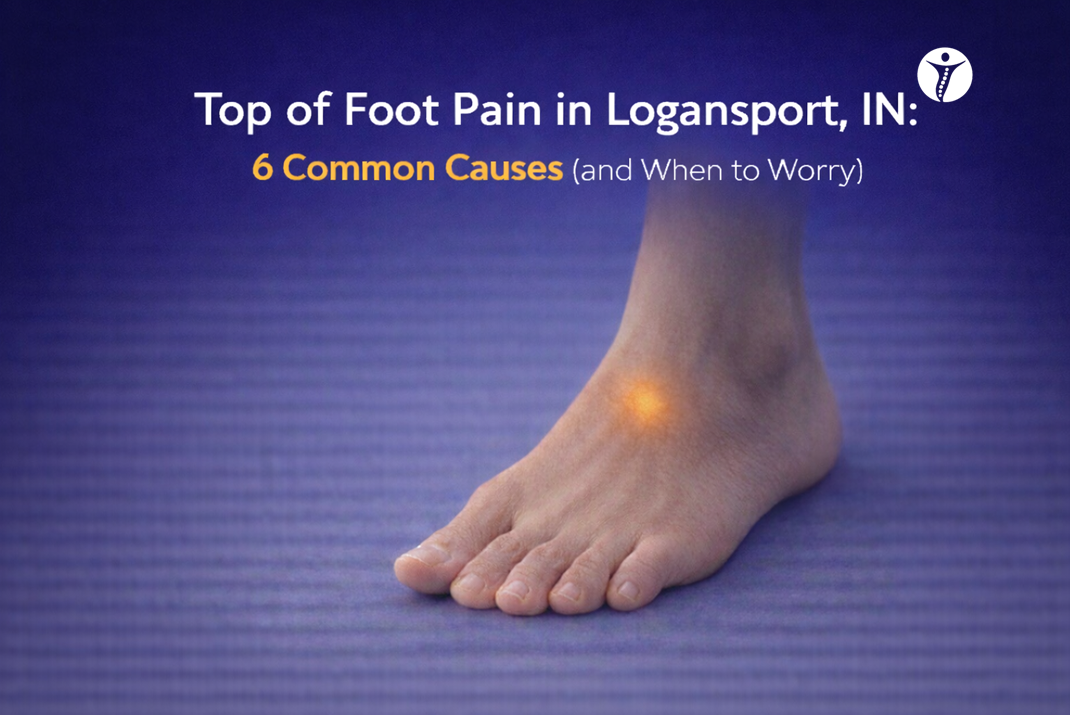
    Infographic showing common causes and pattern clues for top-of-foot pain, including extensor tendon irritation, footwear/lace pressure, midfoot irritation, stress reactions, nerve irritation, and ankle/foot sprain patterns.
    Image 1: Use the pattern clues to narrow the most likely driver—then match the plan to the pattern.
    Footwear + laces can irritate the top of the foot fast
    Volume spikes (walking/running/work) commonly overload extensor tendons
    Swelling/bruising or inability to bear weight = skip to red flags

    Top-of-foot pain (dorsal foot pain) is usually mechanical — but the best first step depends on what’s driving it. If pain keeps returning or you’re not sure what’s safe, start with Foot & Ankle Pain Treatment. If shoe support and mechanics seem to matter, see Custom Orthotics.

    • Fast “shoe & lace” fixes included below
    • Clear causes + what usually helps for each
    • “When to worry” red flags included

    Educational only. Not medical advice. Seek urgent care for severe/worsening symptoms or red flags.

    Start Here: The 4 Clues That Narrow Top-of-Foot Pain Fast

    Not a diagnosis — just a smarter way to decide which “bucket” fits best.

    Supporting visual showing top-of-foot pain location clues and common triggers to narrow the likely driver.
    Image 2: Quick guide—where it hurts + what triggers it are the best clues.

    Clue #1: What triggers it most?

    Shoes/laces (especially pressure on the tongue) points toward compression and extensor irritation. Walking/running volume spikes point toward overload patterns.

    Clue #2: Exactly where is the pain?

    Pain near the ankle/top of the foot can behave differently than pain directly over the midfoot bones. A small, very focal “one spot” tenderness over bone deserves more caution.

    Clue #3: Any swelling or bruising after a twist/fall?

    If yes — think sprain, midfoot injury, or fracture risk. If you can’t bear weight, skip to Red Flags.

    Clue #4: Any burning, tingling, or numbness?

    That can suggest nerve irritation/compression. If symptoms travel or feel “nerve-y,” it’s worth being evaluated. If you also have broader nerve symptoms, see Numbness & Tingling Treatment.

    2-minute quick win: shoe & lacing fixes (worth trying first)

    If pain is worse in shoes or you notice lace pressure, try these before you do anything fancy:

    • Loosen the top 2 eyelets and avoid cranking the tongue down.
    • Skip the eyelet directly over the painful spot (“window lacing”).
    • Switch shoes for 7–10 days (roomier toe box, softer tongue, less stiff upper).
    • Don’t lace for “lockdown” if it compresses the top of the foot.

    If you keep needing lace fixes, it often means the foot is overloaded or the shoe/support setup isn’t matching your mechanics. That’s where Custom Orthotics may help.

    6 Common Causes of Top-of-Foot Pain (and What Usually Helps)

    Each cause has a slightly different first step. Don’t force the wrong plan.

    1) Extensor tendon irritation (often “extensor tendonitis”)

    Feels like: pain on the top of the foot that worsens with walking/running or lifting the toes upward.

    • Common triggers: volume spikes, hills, new shoes, tight laces
    • What helps: lace/shoe changes + reduce volume 7–10 days + graded strengthening
    • Avoid: “pushing through” sharp pain

    2) Lace pressure / shoe-tongue compression (a very common simple one)

    Feels like: tenderness directly under the laces, often worse in tighter shoes and better barefoot.

    • Common triggers: stiff uppers, tight lacing, high arches with low-volume shoes
    • What helps: window lacing + roomier shoe + reduce compression
    • If it keeps coming back: consider support strategy (orthotics) or gait/load plan

    3) Midfoot joint irritation (top-of-foot “midfoot ache”)

    Feels like: deeper ache over the midfoot that’s worse with longer standing/walking and sometimes stiff in the morning.

    • Common triggers: long days on feet, hard floors, sudden activity increases
    • What helps: load reduction + supportive footwear + gradual tolerance build
    • Helpful next step: evaluation of foot mechanics and support

    4) Stress reaction / stress fracture concern (less common, higher importance)

    Feels like: a focal “one spot” pain over bone that worsens with weight-bearing and may persist at rest.

    • Common triggers: new running/walking volume, harder surfaces, low recovery
    • What helps: stop the provoking load; get evaluated if suspicion is high
    • Do not ignore: worsening daily pain, swelling, or inability to bear weight

    5) Ankle/foot sprain patterns (including midfoot sprain)

    Feels like: pain after a twist/roll, often with swelling/bruising, sometimes pain on top of the foot near the ankle.

    • Common triggers: inversion/eversion injury, uneven ground
    • What helps: protect early, then progressive mobility/strength; don’t “babysit” it too long
    • Read next: Ankle Sprain Recovery Timeline

    6) Nerve irritation or compression (burning/tingling pattern)

    Feels like: burning, tingling, numbness, or “electric” sensations—sometimes worse with certain shoes.

    • Common triggers: tight footwear, swelling, nerve sensitivity
    • What helps: reduce compression + calm the flare + address upstream drivers
    • Consider evaluation: especially if symptoms spread or include weakness

    What Helps Most (A Simple 3-Step Plan Ladder)

    This is the safest way to calm symptoms while you identify the driver.

    Step 1: Calm the flare (first 48–72 hours)

    • Do the shoe & lace quick wins above
    • Reduce the activity that reliably spikes pain (often long walking, running, hills)
    • Keep pain-safe motion (don’t fully immobilize unless advised)

    Step 2: Rebuild tolerance (days 4–14)

    • Gradually reintroduce walking minutes (small increases)
    • Add light strengthening in pain-safe ranges
    • If support helps, consider a footwear/orthotic strategy (Custom Orthotics)

    Step 3: If it’s not improving

    • If pain is focal over bone, worsening daily, or you can’t bear weight → get evaluated
    • If symptoms keep returning → check gait, footwear, and load plan
    • Start here: Foot & Ankle Pain Treatment

    Flare-day swap (if you wake up worse)

    • Cut walking time in half (or switch to bike/pool)
    • Return to pain-safe ranges only
    • Resume progress once the next-day rule is stable

    Want a Clear Answer (Not a Guess)?

    We’ll assess foot + ankle + gait + footwear to pinpoint the driver and build a plan that holds up.

    When to Worry (Red Flags)

    Get checked promptly if any of these are true.

    • Unable to bear weight or you’re limping significantly
    • Significant swelling/bruising after a twist, fall, or impact
    • Pain that is worsening day-to-day despite reducing activity
    • Very focal bony tenderness (one spot) with weight-bearing pain
    • Hot/red foot with fever or systemic symptoms
    • Numbness/weakness or rapidly spreading “nerve” symptoms

    If you’re unsure, start with Contact & Location and we’ll guide you.

    Top-of-Foot Pain FAQs

    Quick answers—including “when to worry.”

    Can shoe laces cause top-of-foot pain?
    Yes. Tight laces and certain shoe tongues can compress extensor tendons and nerves on the top of the foot. Lacing changes often help quickly.
    Is top-of-foot pain usually extensor tendonitis?
    Extensor tendon irritation is common, especially with volume spikes or lace pressure. But midfoot irritation, stress reactions, and nerve irritation can mimic it—pattern clues help narrow the bucket.
    Could this be a stress fracture?
    Sometimes. Worsening weight-bearing pain, focal bony tenderness, swelling, and pain that persists at rest can be warning signs. If you suspect a stress fracture, get evaluated.
    How long does it take to improve?
    Many overload and tendon irritation cases improve over 1–3 weeks with footwear changes and graded load. Stress reactions or stubborn midfoot irritation can take longer.
    Do I need imaging?
    Not always. Imaging is more appropriate with trauma, inability to bear weight, worsening swelling/bruising, suspected stress fracture, or stalled progress.
    What’s the best first step?
    Start with a shoe/lacing adjustment and reduce the activity that reliably spikes pain for 7–10 days while keeping gentle motion.
    When should I worry and get checked?
    Get checked urgently if you can’t bear weight, have significant swelling/bruising after a twist/fall, pain is worsening daily, the foot is hot/red with fever, or you have numbness/weakness.
    Can orthotics help?
    Sometimes. If mechanics and load distribution are contributing, arch support and footwear strategy can reduce strain. The best approach is an exam-guided plan matched to your gait and symptoms.

  • Plantar Fasciitis in Logansport, IN: Morning Heel Pain Fixes That Actually Help

    Plantar Fasciitis in Logansport, IN: Morning Heel Pain Fixes That Actually Help

    FOOT & ANKLE PAIN · PLANTAR FASCIITIS · LOGANSPORT, IN

    Morning heel pain pattern guide Support + strength + load plan Clear “when to worry” rules

    Plantar Fasciitis in Logansport, IN: Morning Heel Pain Fixes That Actually Help

    If your first steps out of bed feel sharp, tight, or bruised under the heel, this guide is for you.

    Plantar fasciitis morning heel pain guide showing first-step pain, supportive footwear, gentle warm-up, and progressive loading.
    Image 1: Morning heel pain usually needs support, gentle warm-up, and progressive loading—not aggressive stretching.
    First-step pain usually comes from stiff tissue being loaded suddenly
    Support before standing often beats stretching after it already hurts
    Long-term improvement comes from load control + calf/foot strength

    Plantar fasciitis is one of the most common causes of morning heel pain—that sharp, bruised, or stabbing feeling during the first few steps out of bed. The goal is not to “stretch harder.” The goal is to reduce the first-step load, support the foot, calm the irritated tissue, and gradually rebuild tolerance. For the full service overview, start with Plantar Fasciitis Treatment. If your pain involves more of the foot or ankle, see Foot & Ankle Pain Treatment.

    • Morning routine: what to do before your first steps
    • Fixes ranked by what usually matters most
    • Clear signs it may not be “just plantar fasciitis”

    Educational only. Not medical advice. Seek urgent care for severe/worsening symptoms or red flags.

    Quick Answer: What Usually Helps Morning Heel Pain Fastest?

    The fastest practical fix is usually a combination of support before standing, gentle foot/calf warm-up, and reducing the biggest load spike for a few days. Long-term improvement usually requires progressive calf and foot strengthening—not just stretching.

    Supporting image showing a first-step routine for plantar fasciitis, including gentle warm-up, supportive shoes, and next-day symptom tracking.
    Image 2: Start with the first-step routine—warm up the foot before loading it.
    1

    Before you stand

    Do 60–90 seconds of gentle ankle pumps, toe curls/spreads, and calf movement before the first step.

    2

    Support immediately

    Put on supportive shoes or recovery sandals before walking around. Avoid barefoot hard-floor steps early.

    3

    Track the next day

    If pain is worse the next morning, your total load was too high. Reduce steps, hills, standing time, or intensity.

    The key principle

    Plantar fasciitis often behaves like a load-tolerance problem. That means your foot is not “broken” — it is irritated by more stress than it can currently handle. The fix is to calm the tissue, support it, and rebuild capacity gradually.

    Why Plantar Fasciitis Hurts Most in the Morning

    That sharp first-step pain is one of the clearest plantar fasciitis patterns.

    Overnight stiffness + sudden loading

    While you sleep, the calf/Achilles/plantar fascia chain can stiffen. Then the first few steps suddenly load the bottom of the heel and arch. That quick jump from “rested and stiff” to “fully loaded” is why the first steps can feel so sharp.

    Why it may feel better after you walk

    As the tissue warms up, symptoms often ease. But that does not always mean it is fixed. If the pain returns every morning, the underlying load problem is still present.

    Why aggressive stretching can backfire

    Stretching hard into sharp pain can irritate the tissue more. Gentle mobility is useful. Forced stretching is different. Your goal is to warm the tissue, not win a flexibility contest.

    The First-Step Routine: Do This Before You Stand

    Use this before your first bathroom trip, before long standing, or after sitting for a while.

    Step 1: Gentle ankle pumps

    • Move the ankle up and down slowly
    • Do 20–30 reps before standing
    • Keep it easy—not aggressive

    Step 2: Toe curls and toe spreads

    • Curl and relax the toes gently
    • Spread toes if comfortable
    • Do 10–20 slow reps

    Step 3: Gentle calf warm-up

    • Point and flex the foot
    • Use a towel only if it stays mild
    • No sharp stretching

    Step 4: Shoes before steps

    • Put supportive shoes/sandals by the bed
    • Avoid barefoot hard-floor walking
    • Track whether first-step pain improves in 3–7 days

    If this routine helps but symptoms keep returning, the next question is usually support + mechanics. See Custom Orthotics vs. OTC Inserts and Custom Orthotics.

    5 Fixes That Actually Help Plantar Fasciitis

    These are the big levers: reduce the load spike, support the foot, and rebuild tolerance.

    1) Stop barefoot “first steps”

    This is often the simplest high-impact change. Keep supportive shoes, recovery sandals, or house shoes beside the bed. The goal is to reduce the sharp first-step load while the tissue is stiff.

    2) Temporarily reduce the biggest aggravator

    Common aggravators include long standing, hills, speed walking, running, hard floors, and sudden increases in steps. You do not need to stop moving completely — you need to reduce the specific load that keeps re-irritating the heel.

    3) Build calf and foot strength gradually

    Long-term improvement usually requires stronger calves and feet. Start with pain-safe calf raises, toe control, and foot intrinsic work. Keep symptoms stable the next day before progressing.

    4) Use shoes that match the job

    If you stand on hard floors, walk all day, or train regularly, flimsy shoes may keep symptoms alive. A stable heel counter, enough width, and support that matches your foot can make a major difference.

    5) Consider orthotic support if symptoms keep returning

    Orthotics are not magic, but they can help when mechanics and load distribution are part of the pattern. If you have tried better shoes and basic support and symptoms still repeat, see Custom Orthotics: Do You Need Them?

    What not to do

    • Do not aggressively stretch into sharp pain every morning
    • Do not ignore worsening next-day symptoms
    • Do not walk barefoot on hard floors if first-step pain is intense
    • Do not keep increasing steps, hills, or standing time while symptoms are escalating

    Shoes, Inserts, and Custom Orthotics: What Should You Try First?

    The best support depends on your symptoms, shoes, workload, and how often the pattern returns.

    Scenario Best First Step Why
    First-time mild flare Supportive shoes + short-term OTC insert Many mild cases respond when first-step load and hard-floor stress are reduced.
    Recurring morning heel pain Exam + support strategy Repeated flares usually mean mechanics, load, footwear, or calf/foot capacity need a plan.
    Work on hard floors Stable shoes + possible custom support Long standing creates repeated load. The shoe/orthotic combination matters.
    OTC inserts helped but not enough Consider custom orthotics Custom support may better match your foot mechanics, shoes, and daily demands.
    Numbness, burning, or spreading symptoms Get evaluated That pattern may involve nerve irritation or another diagnosis, not just plantar fascia pain.

    Quick shoe checklist

    • Heel counter: stable, not collapsing
    • Width: enough room for toes and insert/support
    • Midsole: not worn out or flattened
    • Use-case: work shoes, walking shoes, and running shoes may need different support

    A Simple 7-Day Calmer-Heel Plan

    Use this to reduce the morning pain spike and start rebuilding tolerance.

    1

    Days 1–2: Calm the first step

    • Supportive shoes before walking
    • 60–90 second pre-stand routine
    • Reduce hills, long walks, and hard-floor barefoot time
    2

    Days 3–4: Add gentle strength

    • Short, pain-safe calf raises
    • Toe control and foot intrinsic work
    • Stop if sharp pain increases
    3

    Days 5–6: Build walking tolerance

    • Flat walking in supportive shoes
    • Keep walks short enough that next morning is stable
    • Avoid “testing it” with long hills or speed work
    7

    Day 7: Review the pattern

    • Is first-step pain lower?
    • Are you less sore the next morning?
    • If not improving, get the mechanics checked

    How to know you are on the right track

    First-step pain should gradually become less intense, settle faster, and show fewer next-day flare-ups. If pain is worsening day-to-day, the plan is too aggressive or the diagnosis may need a closer look.

    Want a Plan Matched to Your Feet, Shoes, and Daily Routine?

    We’ll evaluate the heel, foot mechanics, calf/Achilles chain, footwear, and walking pattern—then build a plan that fits your actual life.

    When to Worry About Heel Pain

    Most morning heel pain is mechanical, but some patterns deserve prompt evaluation.

    • Unable to bear weight or pain is rapidly worsening
    • Major swelling or bruising, especially after a twist, fall, or injury
    • Hot/red foot, fever, or feeling sick with foot pain
    • Numbness, tingling, burning, or weakness that spreads or worsens
    • Pain that is worsening day-to-day despite reducing activity
    • Heel pain that does not fit the classic “first-step pain that warms up” pattern

    If you’re unsure, start with Contact & Location and we’ll guide you.

    Plantar Fasciitis FAQs

    Quick answers for morning heel pain, support, stretching, orthotics, and when to get checked.

    Why is plantar fasciitis worst in the morning?
    Overnight, the plantar fascia and calf/Achilles complex can stiffen. The first steps suddenly reload the tissue, which can create sharp heel pain until the area warms up.
    What is the fastest thing that helps morning heel pain?
    Support plus gentle warm-up usually helps most. Put supportive shoes on before walking, do 60–90 seconds of gentle foot and calf mobility before standing, and reduce the main aggravator for a few days.
    Should I stretch plantar fasciitis aggressively?
    Usually no. Aggressive stretching into sharp pain can flare symptoms. Gentle mobility, supportive footwear, load management, and progressive calf/foot strengthening usually work better.
    Do custom orthotics help plantar fasciitis?
    Sometimes—especially when foot mechanics and load distribution are major drivers or when symptoms keep returning despite good shoes and basic support. Orthotics work best when paired with strength and load progression.
    Can I walk with plantar fasciitis?
    Often yes, if walking does not cause limping or worsening next-day pain. Flat, shorter walks in supportive shoes are usually better than long walks, hills, barefoot steps, or pushing through sharp pain.
    How long does plantar fasciitis take to improve?
    Many cases improve over several weeks with consistent support, progressive strengthening, and load management. Long-standing symptoms often take longer and benefit from a more specific plan.
    When should I worry about heel pain?
    Get checked promptly if you cannot bear weight, have major swelling or bruising, pain is worsening daily, pain followed a clear injury, the foot is hot or red with fever, or symptoms include spreading numbness, tingling, or weakness.
    What should I do first if I think I have plantar fasciitis?
    Start by avoiding barefoot first steps, using supportive shoes, doing a gentle pre-stand warm-up, reducing the main aggravator, and tracking next-day symptoms. If symptoms keep returning, schedule an evaluation.

  • Ankle Sprain Recovery Timeline: What’s Normal, What’s Not, and Rehab Steps

    Ankle Sprain Recovery Timeline: What’s Normal, What’s Not, and Rehab Steps

    FOOT & ANKLE PAIN · RECOVERY TIMELINE · LOGANSPORT, IN

    Clear timeline: normal vs not normal Rehab steps by phase Built to reduce repeat sprains

    Ankle Sprain Recovery Timeline: What’s Normal, What’s Not, and Rehab Steps

    A clear week-by-week guide—plus the strength, balance, and return-to-activity steps that matter most.

    Ankle sprain recovery timeline guide showing normal healing stages, rehab progression, and return-to-activity checkpoints.
    Image 1: A clear ankle sprain timeline—from swelling and stiffness to strength, balance, and return to activity.
    Swelling and bruising can be normal early—trend matters more than one bad day
    Balance + calf/foot strength are key for preventing repeat sprains
    Can’t bear weight, worsening pain, or giving way means get checked

    An ankle sprain can feel “minor” at first—then turn into weeks of swelling, stiffness, and instability if the right rehab is skipped. This guide breaks down what’s normal, what’s not, and how to rebuild ankle confidence safely. If you have recurring ankle pain or repeated sprains, start with Foot & Ankle Pain Treatment. If foot mechanics, footwear, or support may be part of the pattern, see Custom Orthotics.

    • Goal: calm irritation → restore motion → rebuild strength + balance
    • Return to work or sport is based on function—not just “days since injury”
    • Red flags and “when to worry” are included below

    Educational only. Not medical advice. Seek urgent care for severe/worsening symptoms or red flags.

    Quick Answer: How Long Does an Ankle Sprain Take to Heal?

    A mild ankle sprain may improve a lot in 1–3 weeks. A moderate sprain often takes 3–6+ weeks. A more severe sprain, “high ankle” sprain, unstable ankle, or repeat sprain can take 8–12+ weeks and usually needs a more structured plan.

    Supporting visual showing ankle sprain rehab principles including strength, balance, stability, and gradual return to activity.
    Image 2: Strength, balance, and controlled progression help reduce repeat ankle sprains.
    Normal early:

    Swelling, bruising, stiffness, and soreness with walking can be normal in the first several days.

    Improving trend
    Not normal:

    Pain that worsens daily, inability to bear weight, severe instability, numbness, or pain high above the ankle.

    ! Get checked
    Most missed step:

    People stop once walking feels better—but balance, calf strength, and side-ankle control prevent re-sprains.

    Rehab matters

    Start Here: 5 Quick Checks After an Ankle Sprain

    These checks help you decide whether you can start gentle rehab—or whether you should be evaluated first.

    1) Can you bear weight for a few steps?

    If you cannot bear weight, or you have a severe limp, get evaluated to rule out fracture or higher-grade injury. “Walking it off” is not the best strategy when weight-bearing is sharply limited.

    2) Where is the pain?

    Pain on the outside of the ankle is common with many sprains. Pain on the inside ankle, pain at the base of the 5th metatarsal, or pain high above the ankle can change the timeline and should be taken more seriously.

    3) Is swelling/bruising improving week-to-week?

    Bruising can spread toward the heel or toes and still be part of a normal healing response. The bigger question is whether your walking tolerance, swelling, and range of motion are trending better.

    4) Does the ankle feel unstable or like it might “give way”?

    That often means balance/proprioception and peroneal strength need focused work. Instability is one of the biggest reasons people keep re-spraining the same ankle.

    5) Are you testing it every day?

    Repeatedly jumping, cutting, twisting, or walking too far “to see if it’s better” can delay recovery. Rehab should be consistent and progressive—not aggressive.

    Not sure if this is more than a simple sprain? Start with Foot & Ankle Pain Treatment, or if this happened during sport, see Sports & Athletic Performance.

    Ankle Sprain Recovery Timeline: What’s Normal vs. What’s Not

    Use this as a practical guide. Your exact timeline depends on severity, stability, prior sprains, footwear, and how quickly you restore strength and balance.

    Phase What’s often normal What to focus on When to be concerned
    Days 1–3 Swelling, bruising, stiffness, pain with walking Protection, compression, elevation, gentle range Can’t bear weight, severe pain, obvious deformity
    Days 4–10 Gradual improvement; still sore with longer walking Restore motion, gentle strength, supported balance Swelling/pain worsening daily
    Weeks 2–3 Stiff after rest; mild soreness after rehab Calf strength, balance, controlled steps Still limping heavily or feeling unstable
    Weeks 3–6+ Most daily walking is better; sport/work demands may still expose weakness Single-leg strength, hopping/cutting prep, endurance Repeated giving way or inability to progress
    8–12+ weeks More severe sprains may still need rebuilding Return-to-sport/work testing and prevention plan Chronic instability, repeat sprains, persistent swelling

    The most important timeline rule

    Don’t judge recovery by pain alone. An ankle can feel “mostly better” while balance, calf strength, and side-to-side control are still not ready. That gap is where many repeat sprains happen.

    Ankle Sprain Rehab Steps: What to Do by Phase

    The goal is to restore confidence in layers: motion, walking tolerance, strength, balance, then return to harder demands.

    1

    Phase 1 — Calm + Protect

    Best for: first few days after injury or when swelling is still reactive.

    • Compression and elevation as needed
    • Short walking bouts only if tolerated
    • Gentle ankle pumps and circles in a pain-safe range
    • Avoid “testing” painful ranges repeatedly
    2

    Phase 2 — Restore Motion

    Best for: days 4–10 when swelling is improving and walking is less painful.

    • Ankle circles, alphabet, or controlled range work
    • Gentle calf mobility
    • Progress walking on flat ground
    • Begin light band work if symptoms stay calm
    3

    Phase 3 — Strength + Balance

    Best for: weeks 2–3+ when daily walking is improving.

    • Calf raises
    • Band eversion/inversion work
    • Supported single-leg balance
    • Controlled step-ups and step-downs
    4

    Phase 4 — Return to Activity

    Best for: when motion, walking, strength, and balance are close to normal.

    • Longer walks before jogging
    • Jogging before sprinting
    • Linear movement before cutting/pivoting
    • Sport drills before full competition

    Rehab progression rule

    Progress only if symptoms are stable the next day. Mild soreness can be okay. Increased swelling, sharper pain, limping, or new instability means scale back the range, volume, or intensity.

    Can I Walk on a Sprained Ankle?

    Sometimes yes—but walking should help you gradually rebuild tolerance, not keep re-irritating the injury.

    Walking is usually okay if…

    • You can walk without severe pain
    • Your limp is mild and improving
    • Swelling does not spike afterward or the next day
    • You can keep walks short, flat, and controlled

    Scale back walking if…

    • You limp more as the walk continues
    • Swelling increases later that day
    • Pain is sharper with each step
    • You feel unstable on uneven ground

    Do braces, shoes, or orthotics help?

    An ankle brace can help early by reducing excessive motion and improving confidence. Shoes matter too—especially heel stability and traction. If repeated sprains, arch collapse, or foot mechanics are part of the pattern, support may be worth discussing. See Custom Orthotics, Do You Need Orthotics? 9 Signs, and Custom Orthotics vs. OTC Inserts.

    Return-to-Work or Sport Rules: Don’t Skip This Step

    Return should be based on what your ankle can do—not just how many days it has been since the sprain.

    Before returning to harder activity, you want:

    • Walking without a meaningful limp
    • Near-normal ankle range of motion
    • Calf raises without sharp pain
    • Single-leg balance that feels controlled
    • No significant swelling increase the next day

    For athletes: the return ladder

    • Step 1: flat walking
    • Step 2: longer walking + light strength
    • Step 3: jogging / linear movement
    • Step 4: controlled agility and direction changes
    • Step 5: sport-specific drills before full competition

    If you’re returning to games, workouts, or cutting sports, see Sports & Athletic Performance and Youth Sports Injuries: When Soreness Is Normal vs. When to Get Checked.

    For work demands: stairs, ladders, uneven ground, and long shifts matter

    If your job requires standing, climbing, lifting, or uneven surfaces, the ankle needs more than “it feels okay at home.” Build tolerance gradually and avoid jumping straight from rest to a full-demand workday.

    Why Ankle Sprains Keep Coming Back

    The biggest issue is usually not that the ligament “didn’t heal.” It’s that balance, strength, and control were never fully rebuilt.

    Balance/proprioception

    Your ankle needs to sense the ground quickly—especially on uneven surfaces or during sport.

    Calf + foot strength

    Strong calves and feet help control load, absorb force, and reduce compensation.

    Footwear + mechanics

    Shoes, arch control, old injuries, and sport/work demands can all change ankle load.

    If your ankle keeps rolling: don’t just rest it again. Get the pattern assessed through Foot & Ankle Pain Treatment so the plan addresses strength, balance, mechanics, and return-to-activity demands.

    Want a Clear Plan for Your Ankle Sprain?

    We’ll check your ankle, identify what phase you’re in, and help you rebuild motion, strength, balance, and confidence—without guessing.

    When to Worry After an Ankle Sprain

    Most sprains improve with the right plan—but these signs deserve prompt evaluation.

    • Unable to bear weight for a few steps after the injury
    • Severe swelling or bruising, especially if worsening
    • Pain high above the ankle or pain that feels different than a typical rolled ankle
    • Obvious deformity, cold foot, or color change
    • Numbness/tingling or symptoms spreading into the foot
    • Repeated giving way or the ankle feels unstable after the acute phase
    • Pain that is worsening day-to-day despite reducing activity

    If you’re unsure, start with Contact & Location and we’ll help guide the next step.

    Ankle Sprain Recovery FAQs

    Quick answers about healing timelines, walking, braces, rehab, and when to get checked.

    How long does a typical ankle sprain take to heal?
    Many mild ankle sprains improve significantly within 1–3 weeks. Moderate sprains often take 3–6+ weeks. Severe sprains, high ankle sprains, unstable ankles, or repeat sprains can take 8–12+ weeks and usually need structured rehab.
    Is swelling and bruising normal after an ankle sprain?
    Yes. Swelling and bruising are common early, and bruising can travel toward the heel or toes. The key is whether swelling, motion, pain, and walking tolerance improve over time.
    Can I walk on a sprained ankle?
    Walking is usually okay if pain is mild, your limp is improving, and swelling does not spike afterward. If you cannot bear weight, have severe pain, or symptoms worsen after walking, get evaluated.
    When should I worry and get my ankle checked?
    Get checked if you cannot bear weight, have severe swelling/bruising, pain high above the ankle, numbness, obvious deformity, worsening daily pain, or repeated giving way.
    What is the most important rehab after an ankle sprain?
    Restore motion first, then rebuild calf/foot strength and balance. Balance/proprioception work is especially important because it helps reduce repeat sprains.
    Do ankle braces help after a sprain?
    They can. A brace can help control excessive motion and improve confidence early on, especially for walking or sport. It should usually be paired with rehab instead of replacing it.
    When can I return to sports after an ankle sprain?
    Return should be based on function, not just time. You should have good walking tolerance, near-normal motion, strength, balance, and the ability to jog, cut, hop, or change direction without pain, swelling, or instability.
    Why do I keep spraining the same ankle?
    Repeat sprains often happen when balance, proprioception, calf strength, foot control, or ankle mobility were never fully restored. Foot mechanics, footwear, and sport/work demands can also contribute.