Category: Arthritis & Joint Pain

Practical arthritis and joint pain education—common patterns, red flags, lifestyle and movement strategies, and evidence-based conservative care options in Logansport.

  • Arthritis in Logansport, IN: 6 Joint Pain Patterns (and What Usually Helps)

    ARTHRITIS & JOINT PAIN · PATIENT EDUCATION · LOGANSPORT, IN

    Arthritis in Logansport, IN: 6 Joint Pain Patterns (and What Usually Helps)

    Arthritis pain isn’t random. The pattern tells you what to do next.

    Stiff after rest, better with movement is a classic arthritis pattern
    Flare-ups often mean load tolerance was exceeded—not that you’re “breaking down”
    Strength + pacing usually improves symptoms more than rest alone

    Arthritis doesn’t mean you should stop moving — it means you need a smarter plan. The goal is to reduce irritation and build capacity so you can do more with less flare-up risk. If symptoms persist or you want a clear plan, start with our Arthritis & Joint Pain Treatment page. If your main pain is the knee or hip, we’ll treat the chain—not just one joint.

    • Low-impact movement nourishes joints and reduces stiffness
    • Strength protects joints long-term
    • “When to worry” red flags included below

    Educational only. Not medical advice.

    Start Here: 4 Quick Clues That Narrow Arthritis Patterns Fast

    These “big clues” help you choose the safest next step without guessing.

    1) Morning stiffness that improves as you move

    This is a common arthritis pattern. Gentle movement often reduces symptoms more than rest.

    2) Soreness after long days (standing, stairs, lifting)

    Often a load tolerance issue — your joint is doing more than it’s ready for right now.

    3) Flare-ups after doing “too much, too soon”

    Very common. The solution is usually pacing + strength progression (not stopping activity).

    4) Red flags (hot/red joint, fever, sudden inability to bear weight)

    Those deserve evaluation promptly to rule out something beyond routine arthritis irritation.

    6 Joint Pain Patterns We See Most Often

    Each pattern points to a different “first step” and a different progression plan.

    1) Knee arthritis pattern (stairs, squats, long walks)

    Often shows up as stiffness after sitting and soreness with stairs or long walks. If knee pain is your main issue, also read Knee Pain in Logansport: 7 Common Causes.

    • Usually helps: quad + hip strength, step-down control, pacing stairs
    • Fast win: reduce deep knee angles for 7–14 days while strength rebuilds

    2) Hip arthritis pattern (groin pain, stiffness getting in/out of car)

    Hip arthritis often presents as groin pain, side hip ache, or stiffness with shoes/socks. See Hip Pain in Logansport: 6 Common Causes for pattern checks.

    • Usually helps: hip mobility + glute strength, shorter stride, smarter walking volume
    • Fast win: switch from hills/stairs to flat walking or bike short term

    3) Hand arthritis pattern (morning stiffness, grip fatigue)

    Common in fingers/thumb base. Symptoms often flare with repetitive gripping and cold exposure.

    • Usually helps: gentle range, warmth, pacing grip-heavy tasks
    • Fast win: short “movement snacks” through the day vs one long session

    4) Spine arthritis pattern (neck/low back stiffness)

    Typically stiffness after rest that improves with movement. If low back is the main issue, see Low Back Pain Treatment.

    • Usually helps: mobility + core/hip strength + consistent walking
    • Fast win: shorter walks more often (frequency beats intensity)

    5) Shoulder arthritis pattern (overhead reach and behind-the-back limits)

    Often stiffness and pain with reaching overhead or behind your back. If shoulder pain is the main complaint, see Shoulder Pain Treatment.

    • Usually helps: shoulder blade mechanics + gentle strength progression
    • Fast win: reduce repetitive overhead work temporarily

    6) “Flare-up” pattern (the joint gets cranky for days after a spike)

    This is the most common pattern we see: you do more than the joint is ready for, symptoms flare, then the fear cycle starts. The fix is usually pacing + progressive strength — not quitting activity.

    • Usually helps: calm irritability first, then build capacity weekly
    • Fast win: swap impact/stairs for low-impact (bike/flat walking) for 7 days

    Want a Joint Plan That’s Clear and Realistic?

    We’ll match your symptoms to the most likely driver, reduce flare-ups, and build strength so your joints hold up better. If you want a step-by-step template, start with the 7-Day Low-Impact Plan.

    When to Worry (Red Flags)

    Get checked promptly if any of these are true.

    • Hot, red, very swollen joint (especially with fever)
    • Sudden inability to bear weight or a severe limp
    • Rapidly worsening pain day-to-day
    • True locking (joint stuck)
    • Significant symptoms after a clear injury

    Not sure? Start with Contact & Location and we’ll point you in the right direction.

    Arthritis FAQs

    Quick answers—including “when to worry.”

    What causes arthritis flare-ups?
    Most flare-ups happen when daily load exceeds your current tolerance. The fix is pacing + strength progression, not quitting movement.
    Should I rest or move when arthritis flares?
    Most people do best with gentle, consistent movement in a symptom-safe range rather than complete rest.
    How do I know if my pain is arthritis or something else?
    Arthritis often feels stiff after rest and better with movement. Sharp locking, major swelling, fever, or inability to bear weight deserves evaluation.
    When should I worry?
    Get checked promptly for a hot/red joint with fever, severe swelling, rapidly worsening pain, true locking, or sudden inability to bear weight.
    Do chiropractic adjustments help arthritis?
    Sometimes. Appropriate chiropractic care plus strength/mobility and pacing can improve motion and comfort when mechanics are part of the driver.
    How long does it take to improve?
    Many people improve over a few weeks with the right plan. Longer-standing cases often respond best to a structured 6–12+ week progression.

  • Osteoarthritis vs. Rheumatoid Arthritis: How to Tell (and When to Get Help)

    ARTHRITIS & JOINT PAIN · DECISION GUIDE · LOGANSPORT, IN

    Osteoarthritis vs. Rheumatoid Arthritis: How to Tell

    Different patterns. Different next steps.

    If you’ve been told you have “arthritis,” it’s worth clarifying which kind. This guide explains common OA vs. RA clues—and when it’s smart to pursue further evaluation.

    Educational only. Not medical advice. If you suspect inflammatory arthritis or have red flags, consult your primary care provider promptly.

    Quick Comparison: OA vs. RA Patterns

    These aren’t absolutes—but they’re helpful “directional” clues.

    Osteoarthritis (OA) often looks like:

    • Joint stiffness that eases as you warm up
    • Pain tied to load (stairs, gripping, long walks)
    • One or a few joints more than many
    • Flare-ups after overdoing activity

    Rheumatoid arthritis (RA) often looks like:

    • Longer morning stiffness + persistent swelling
    • Multiple joints involved (often both sides)
    • Fatigue, feeling run-down, systemic symptoms
    • Symptoms that progress without a clear “overuse” trigger

    The goal isn’t to self-diagnose—it’s to choose the right next step: conservative load strategy vs. medical evaluation (or both).

    When to Pursue Further Evaluation

    Consider checking in with your PCP if you notice:

    • Visible, persistent swelling in multiple joints
    • Morning stiffness lasting a long time, most days
    • Symptoms affecting both sides (both hands/wrists, etc.)
    • Unexplained fatigue, feverish feelings, or weight changes
    • Rapid progression over weeks

    Conservative Comfort Steps That Often Help

    Whether it’s OA, RA, or something else, these foundations usually support better days:

    1

    Load management

    Pick the smallest change that reduces flare-ups: shorter walks, fewer stairs trips, larger grips, more breaks.

    2

    Low-impact strength

    Stable strength improves tolerance. Think: gentle, repeatable, pain-aware—not “go hard.”

    3

    Movement variety

    Swap long static positions for frequent micro-movement. Your joints like options.

    If you’d like, we can evaluate your pattern and build a plan you can actually maintain.

    Want Help Clarifying What Type of Arthritis Pattern You Have?

    We’ll assess mechanics, discuss your symptoms clearly, and coordinate next steps if medical evaluation is appropriate.

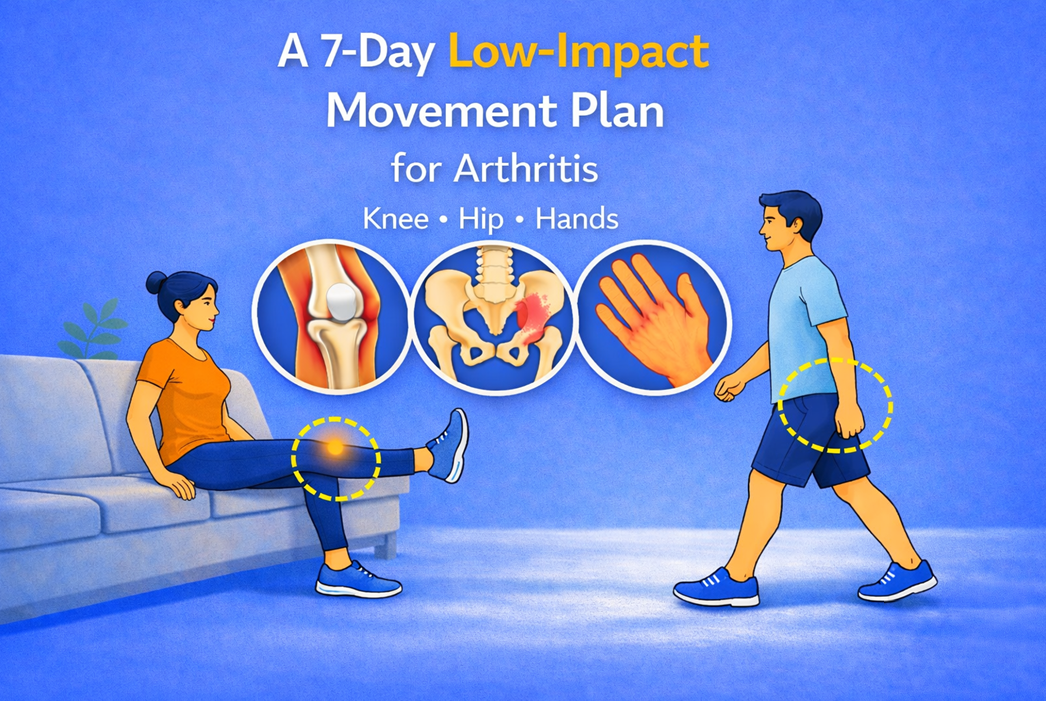
  • A 7-Day Low-Impact Movement Plan for Arthritis (Knee, Hip, or Hands)

    ARTHRITIS & JOINT PAIN · PATIENT EDUCATION · LOGANSPORT, IN

    A 7-Day Low-Impact Movement Plan for Arthritis (Knee, Hip, or Hands)

    A realistic plan to reduce stiffness and protect joints—without flaring symptoms.

    Daily movement improves stiffness and confidence
    Low-impact + light strength protects arthritic joints
    Progressive—not aggressive—wins long-term

    Arthritis doesn’t mean you should stop moving—it means you need a smarter plan. The right kind of movement reduces stiffness, improves joint nutrition, and builds long-term confidence. If pain is persistent or you’re unsure what’s safe, start with Arthritis & Joint Pain Treatment.

    • Mild soreness is okay; sharp pain is not
    • Your joints should feel the same or better the next day
    • Consistency matters more than intensity

    Educational only. Not medical advice. Seek urgent care for severe/worsening symptoms or red flags.

    Start Here: How to Use This Plan Safely

    Use this as a template. Adjust reps and range so symptoms calm within 24 hours.

    Rule #1: Symptoms should be stable or improved the next day.
    Better Same Slightly sore
    Rule #2: Avoid “spike” activities for 7 days (deep loaded squats, jumping, long hills). Replace with bike, flat walking, pool, and controlled strength.
    Rule #3: If swelling increases or pain worsens over 24–48 hours, scale back volume and range.

    The 7-Day Low-Impact Arthritis Movement Plan

    Most people do best with daily gentle movement + 2–3 strength days per week.

    Before you start (2 minutes)

    • Pick your target joint: knee, hip, or hands
    • Choose your cardio: flat walking, cycling, pool
    • Choose a “green range”: pain-free or mild discomfort only

    Day 1 — Mobility (10–15 minutes)

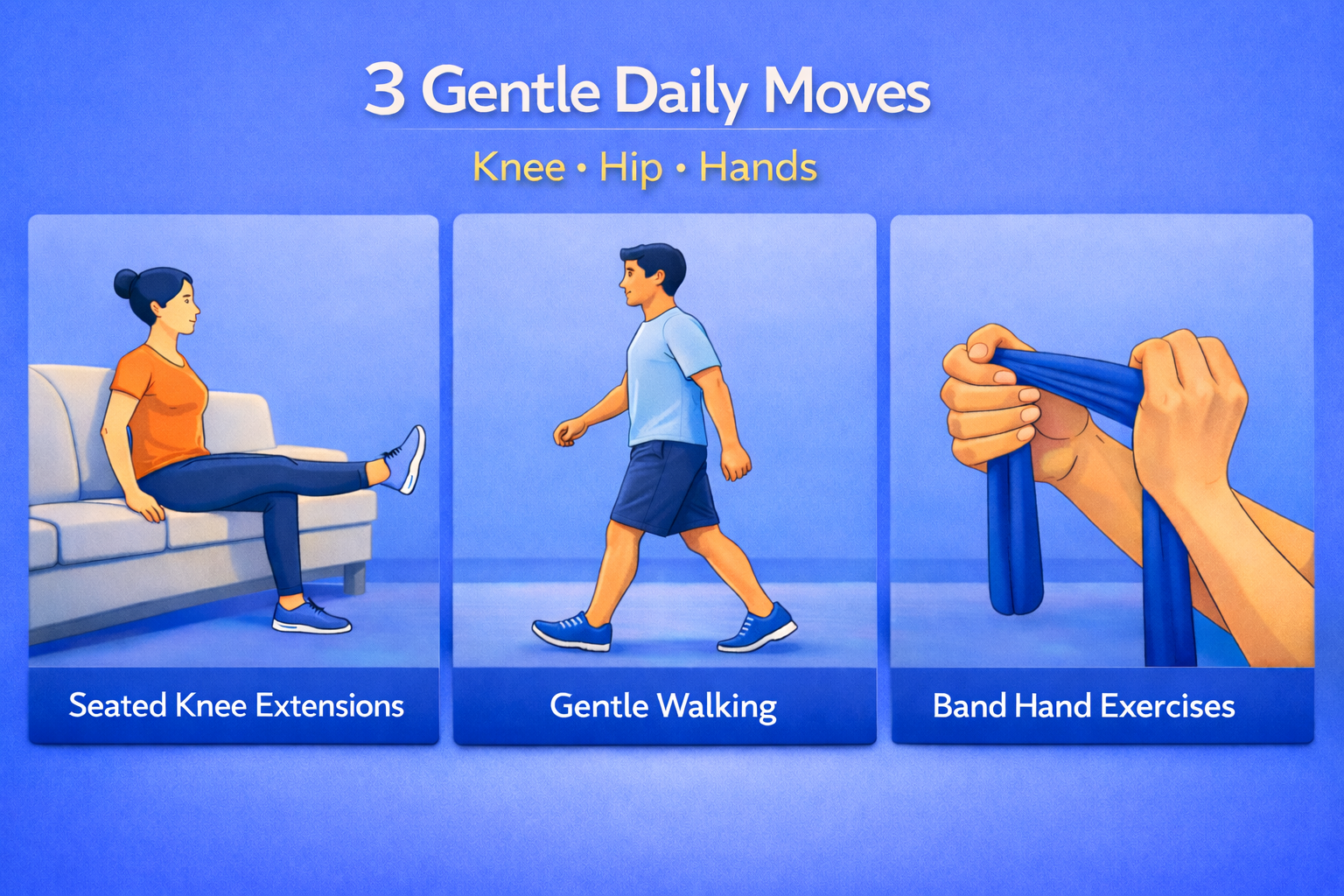
    • Knees: gentle knee bends + easy quad activation
    • Hips: hip circles + controlled bridges
    • Hands: open/close, tendon glides, gentle grip squeezes

    Day 2 — Light Strength (15–20 minutes)

    • Knees: sit-to-stand (chair), mini-squats (shallow)
    • Hips: bridges + side steps (band if tolerated)
    • Hands: light putty/ball squeezes + wrist extensor work

    Day 3 — Low-Impact Cardio (15–30 minutes)

    • Zone 2 pace (you can talk)
    • Flat walking, bike, or pool
    • Stop if limping begins or pain escalates sharply

    Day 4 — Mobility + Balance (10–15 minutes)

    • Easy mobility (repeat Day 1)
    • Balance: supported single-leg stance (as tolerated)

    Day 5 — Strength Repeat (15–20 minutes)

    • Repeat Day 2
    • Use a slower tempo (control over load)

    Day 6 — Active Recovery (10–20 minutes)

    • Short walk or bike
    • Gentle range work only

    Day 7 — Optional Rest or Light Mobility

    • If stiff: do Day 1 mobility
    • If calm: take a true rest day

    If your knee is a major limiter, see Knee Pain Treatment. If your hip is a major limiter, see Hip Pain Treatment.

    Want a Plan Tailored to Your Arthritis?

    We’ll match your plan to your joints, your lifestyle, and your goals—so you’re not guessing. If mechanics matter (feet/knees/hips), we’ll address the chain.

    When to Worry (Red Flags)

    Get checked promptly if any of these are true.

    • Rapidly worsening swelling or a hot, red joint (especially with fever)
    • Joint giving way, locking, or a sudden inability to bear weight
    • Pain that is worsening day-to-day despite reducing activity
    • New numbness/tingling or symptoms that don’t fit your usual pattern

    Arthritis Movement FAQs

    Quick answers—including “when to worry.”

    Is it safe to exercise with arthritis?
    Yes—when the plan matches your tolerance. Low-impact movement and light strength are protective for most people.
    How often should I move if I have arthritis?
    Daily gentle movement plus 2–4 strength days per week is a strong baseline for most people.
    What exercises should I avoid with arthritis?
    Avoid high-impact and deep loaded positions that cause sharp pain or swelling that worsens over the next 24–48 hours.
    How long does it take to feel improvement?
    Many people notice reduced stiffness within 1–2 weeks with consistent movement. Strength improvements build over time.
    When should arthritis pain be evaluated?
    If pain is rapidly worsening, swelling is persistent, the joint locks/gives way, or daily function is limited despite consistent movement, get checked.
    What’s the best cardio for arthritis?
    Flat walking, cycling, and pool exercise are common options. The best choice is what you can do consistently without flaring symptoms.