Author: Dr. Tyler Graham, DC

  • Knee Pain on Stairs: Why It Happens (and 5 Fixes That Usually Help)

    Knee Pain on Stairs: Why It Happens (and 5 Fixes That Usually Help)

    KNEE PAIN · STAIRS SELF-SORTER · LOGANSPORT, IN

    Evidence-informed, conservative-first guidance Pattern clues by pain location Clear “when to worry” rules

    Knee Pain on Stairs: Why It Happens (and 5 Fixes That Usually Help)

    Stairs load the knee harder than flat walking—so small issues show up fast. Use the self-sorter and the 5-fix plan.

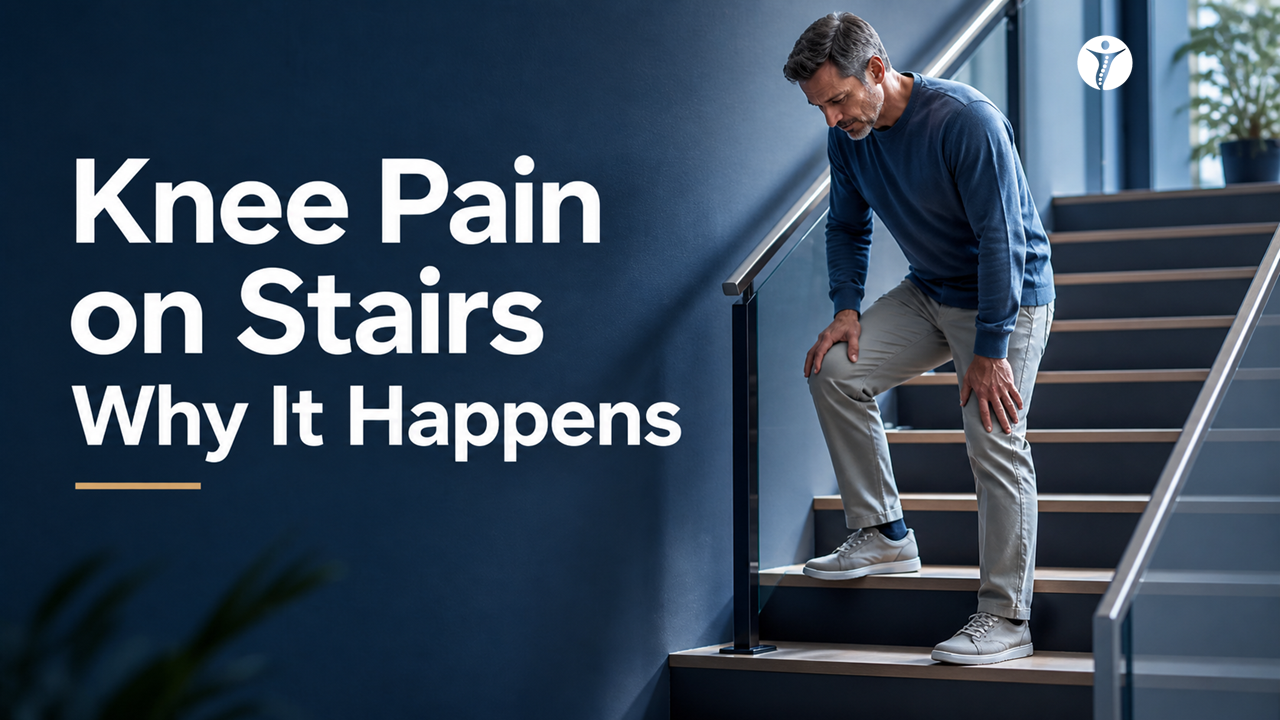
    Infographic showing knee pain on stairs patterns by pain location (front, inside, outside, back) and first-step fixes.
    Image 1: Stairs pain patterns—front vs inside vs outside vs back—plus what to do first.
    Front knee pain often = kneecap/patellar tendon load
    Inside pain can be meniscus/arthritis patterns (get checked if persistent)
    Fixes: reduce spike + rebuild quads/hips + technique tweaks

    Knee pain on stairs is common in Logansport—especially if your workload or activity volume recently increased. If you want the full knee overview, start here: Knee Pain Treatment. If you’re trying to self-sort meniscus vs runner’s knee patterns, see Runner’s Knee vs. Meniscus.

    • 60-second self-check + pattern map
    • 5 fixes with dosing (what to do first)
    • Clear “when to worry” guidance

    Educational only. Not medical advice. Patterns overlap—an exam confirms the driver.

    Quick Answer (Why Stairs Hurt)

    Stairs increase knee bend (knee flexion) and joint/tendon load. That means small irritations can flare quickly—especially if quad/hip capacity isn’t keeping up.

    Supporting visual reinforcing the knee pain on stairs plan: reduce load spike, rebuild quad and hip strength, and progress tolerance gradually.
    Image 2: Reduce the spike, rebuild the quads/hips, and progress stairs tolerance gradually.

    Most common drivers

    • Patellofemoral load (front-of-knee / kneecap pattern)
    • Tendon overload (patellar tendon)
    • Capacity gap (quads/hips/endurance not matching stair volume)

    What usually works first

    • Reduce the spike (volume/step height/pace) for 7–14 days
    • Rebuild quads + hips with pain-safe progression
    • Technique tweaks (downstairs especially)

    60-Second Self-Check (Pattern Sorter)

    Answer quickly. The goal is direction—not certainty.

    1) Is pain mainly front of knee (around kneecap)?
    2) Is pain mainly inside joint line?
    3) Is pain mainly outside knee?
    4) Is pain mainly behind knee?
    5) Worse going down than up?
    6) Any swelling, locking, or giving way?

    How to interpret it

    • Front pain + down worse: often patellofemoral / quad capacity pattern.
    • Front pain below kneecap: often patellar tendon overload.
    • Inside joint line + swelling/catching: meniscus/arthritis patterns → get checked if persistent.
    • Swelling/locking/giving way: evaluate sooner.

    Why It Happens (Top Patterns)

    Use pain location + stair clues to narrow the most likely driver.

    1

    Patellofemoral pain (kneecap overload)

    Feels like: front-of-knee ache, worse downstairs or after sitting.

    Helps first: reduce spike + quad/hip progression + technique.

    2

    Patellar tendon irritation

    Feels like: pain just below kneecap, worse with jumping/squats/stairs.

    Helps first: isometrics + graded loading (not total rest).

    3

    Meniscus irritation pattern

    Feels like: inside joint-line pain, catching, swelling after activity.

    Helps first: evaluation + smart load plan; avoid twisting under load.

    4

    Arthritis / joint irritation

    Feels like: stiffness + ache, often worse after inactivity.

    Helps first: low-impact movement + strength + tolerance building.

    5

    Hip weakness / valgus control (knee collapses inward)

    Feels like: front/inside pain with stairs or step-downs.

    Helps first: glute control + single-leg stability progression.

    6

    Lateral/IT band–type pattern (less common)

    Feels like: outside knee pain, often with repetitive steps.

    Helps first: hip control + volume management + mechanics.

    Not sure which one fits?

    If you’re deciding between runner’s knee vs meniscus, start here: Runner’s Knee vs. Meniscus (How to Tell).

    5 Fixes That Usually Help (Mini Protocols)

    Use the next-day rule: you should feel the same or better the next day (mild soreness is okay).

    Fix #1: Reduce the spike (7–14 days)

    • Use the rail temporarily, slow down, and reduce total stair reps
    • Choose shorter steps when possible
    • Avoid deep loaded knee bends that spike pain

    Fix #2: Quad capacity (the biggest win)

    • Start with pain-safe quad isometrics (short holds)
    • Progress to step-downs or sit-to-stands in a tolerable range
    • Progress volume before intensity

    Fix #3: Hip/glute control

    • Band walks or side-steps (tolerable dose)
    • Single-leg balance work with good alignment
    • Reduce knee “collapse” during stairs/step-downs

    Fix #4: Mobility that actually helps

    • Ankle mobility (if you feel forced into awkward knee angles)
    • Hip mobility (pain-safe)
    • Avoid aggressive knee stretching into sharp pain

    Fix #5: Technique tweaks (stairs & squats)

    • Downstairs: slow the lowering (eccentric control)
    • Use the whole foot (“tripod”), not just toes
    • Small forward trunk lean can reduce kneecap load for some people

    If you suspect arthritis patterns

    A low-impact movement plan can help: A 7-Day Low-Impact Movement Plan for Arthritis.

    Up vs Down Stairs (Why Down Usually Hurts More)

    Downstairs demands more braking (eccentric control). That’s why kneecap/tendon patterns show up fast.

    Downstairs tips (high ROI)

    • Use the rail short-term while you rebuild strength
    • Slow down (control the descent)
    • Reduce step height or number of trips temporarily
    • Stop if form collapses or pain spikes sharply

    Simple rule

    If downstairs is the main trigger, quad endurance + step-down progression is usually the best long-term fix.

    When to Worry (Red Flags)

    Get checked promptly if any of these are present.

    • True locking (knee gets stuck)
    • Repeated giving way or sudden instability
    • Large swelling or rapidly worsening swelling
    • Unable to bear weight or severe worsening pain
    • Fever/hot red joint or feeling very unwell
    • Major trauma (fall, collision)
    • Severe night pain that keeps escalating

    If you’re unsure, start with Contact & Location and we’ll guide you.

    Want a Knee Plan That Fits Your Stairs and Daily Life?

    We’ll identify your pattern (kneecap, tendon, meniscus/arthritis, hip control) and build a progression that holds up.

    Knee Pain on Stairs FAQs

    Quick answers—including meniscus questions and imaging.

    Why does my knee hurt more going down stairs?
    Downstairs requires more eccentric control (braking). That increases kneecap and tendon load, so small irritations show up quickly—especially with weak quads/hip control or increased stair volume.
    Is knee pain on stairs always a meniscus problem?
    No. Front-of-knee pain is often patellofemoral or tendon overload. Meniscus patterns are more likely with joint-line pain, swelling, catching/locking, or pain with twisting—an exam helps confirm.
    Should I stop using stairs completely?
    Not always. Many people improve with temporary load reduction plus a progressive strengthening plan—then gradually reintroduce stairs as tolerance improves.
    What are the best exercises for knee pain on stairs?
    A strong start is pain-safe quad strength (isometrics/step-down progression) plus hip/glute control. The best plan is one you can do consistently with a stable next-day response.
    Do I need imaging for knee pain on stairs?
    Often not initially if there are no red flags and you’re improving. Imaging is more important with true locking, large swelling, inability to bear weight, major trauma, or persistent/worsening symptoms.
    How long does it take to improve?
    Many people improve over a few weeks with consistent load management and strengthening. Longer-standing patterns can take longer but still respond well to a staged plan.
    Can shoes or orthotics affect knee pain on stairs?
    Sometimes. Worn shoes or poor support can change mechanics and increase knee load. If foot mechanics are a factor, a shoe strategy or orthotics may help alongside strengthening.
    When should I worry and get checked?
    Get checked promptly for true locking, repeated giving way, large swelling, inability to bear weight, fever/hot red joint, major trauma, or severe night pain that escalates.

  • Runner’s Knee vs. Meniscus: How to Tell (and What to Do First)

    Runner’s Knee vs. Meniscus: How to Tell (and What to Do First)

    KNEE PAIN · DECISION GUIDE · LOGANSPORT, IN

    Pattern checks (not guesswork) Clear “when to worry” red flags Conservative first steps that hold

    Runner’s Knee vs. Meniscus: How to Tell (and What to Do First)

    These can feel similar—but the clues (and first step) differ. Use this self-sorter before you guess wrong.

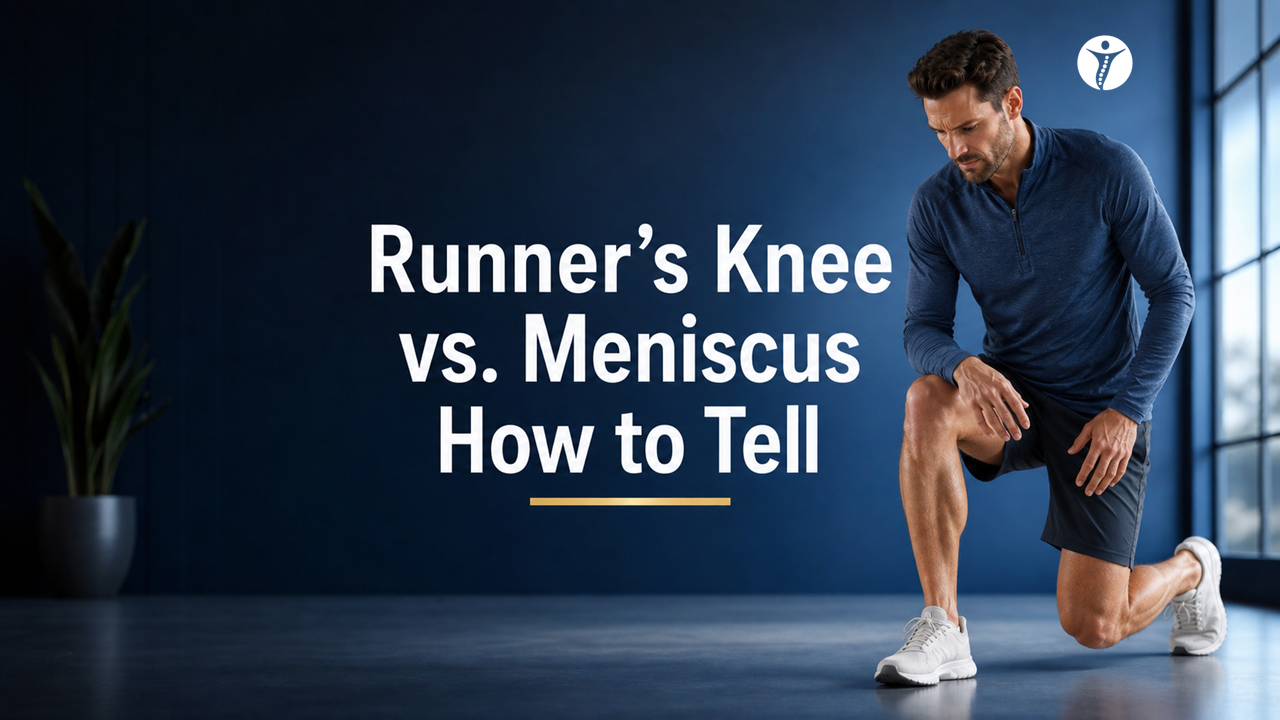
    Infographic comparing runner’s knee and meniscus irritation by pain location, triggers, swelling, and what to do first.
    Image 1: A vs B—location, triggers, swelling, and what to do first.
    Runner’s knee: front/around kneecap + stairs/sitting + volume spikes
    Meniscus: joint-line pain + swelling/catching + twist/deep squat intolerance
    Best next step: reduce spike + choose the right progression

    If your knee hurts with running, stairs, or squats, you’re probably asking: “Is this runner’s knee… or a meniscus problem?” This guide helps you self-sort the pattern, then choose the safest first step. For the service overview, start with Knee Pain Treatment. If stairs are your main trigger, also see Knee Pain on Stairs.

    • 60-second self-check + comparison table
    • What to do first for each pattern
    • Clear “when to worry” guidance

    Educational only. Not medical advice. Patterns overlap—an exam confirms the driver.

    Quick Answer (The Simple Difference)

    Runner’s knee (patellofemoral pain) is usually a front-of-knee / kneecap overload and capacity problem. Meniscus irritation is more likely when pain is at the joint line and paired with swelling or mechanical symptoms (catching/locking).

    Supporting visual reinforcing runner’s knee vs meniscus decision rules and conservative first steps.
    Image 2: Self-sort first—then choose the right progression (don’t guess).

    One rule that prevents most re-flares

    Use the next-day rule: you should feel the same or better the next day (mild soreness is okay). If you swell or worsen, scale down and reassess.

    60-Second Self-Check (Pattern Sorter)

    Answer quickly. You’re looking for the dominant pattern.

    Runner’s knee clue: pain is mostly front/around kneecap (not the joint line).
    Runner’s knee clue: worse with stairs, hills, running volume, or after sitting (“movie sign”).
    Meniscus clue: pain is at the joint line (inside or outside “crease” of knee).
    Meniscus clue: swelling after activity, catching, or pain with twisting/deep squat.
    Red flag clue: knee locks (gets stuck) or gives way repeatedly.
    Red flag clue: large swelling, can’t bear weight, or major trauma.

    Interpretation

    • Mostly runner’s knee clues: treat it like a capacity + load problem (quads/hips + progression).
    • Mostly meniscus clues: treat it like a joint irritation pattern (avoid twists/spikes, restore tolerance).
    • Red flag clues: evaluate sooner.

    Comparison Table (Fast, Skimmable)

    This is the quickest way to self-sort without overthinking it.

    Clue Runner’s Knee (Patellofemoral) Meniscus Irritation Pattern
    Pain location Front/around kneecap Joint line (inside/outside crease)
    Triggers Stairs, hills, sitting-to-standing, volume spikes Twisting, deep squat, pivoting; sometimes stairs too
    Swelling Usually minimal More likely after activity
    Mechanical symptoms Often none Catching/locking more likely
    Best first step Reduce spike + rebuild quads/hips Avoid twist/spike + restore range + graded load
    When to evaluate Persistent, recurrent, or not improving Locking, large swelling, giving way, or persistent mechanical symptoms

    Runner’s Knee Pattern (Patellofemoral Pain)

    This is usually a kneecap load + capacity issue—not a “tear.”

    What it often feels like

    • Front-of-knee ache around kneecap
    • Worse downstairs, hills, or after sitting
    • Often improves after warming up

    Common drivers

    • Running/stairs volume spike (too much too soon)
    • Quad/hip capacity gap (endurance and control)
    • Technique/mechanics: knee “collapse” inward under load

    Big mistake

    Total rest for a week, then going right back to the same volume. A staged progression holds better.

    Meniscus Irritation Pattern

    Keep it calm: “meniscus pain” doesn’t always mean surgery. Many patterns improve conservatively—red flags change the pathway.

    What it often feels like

    • Joint-line pain (inside or outside crease)
    • Swelling after activity
    • Catching, sharp pain with twisting, or deep squat intolerance

    What usually helps first

    • Avoid twisting/pivoting and deep squat spikes temporarily
    • Restore range and reduce swelling
    • Strength in tolerable ranges + graded return

    Evaluate sooner if…

    • True locking (knee gets stuck)
    • Large/recurrent swelling
    • Repeated giving way or inability to bear weight

    What to Do First (Two Ladders)

    Choose the ladder that fits your dominant pattern.

    Runner’s knee ladder

    1. Reduce spike: temporarily reduce hills/stairs/volume for 7–14 days
    2. Quads: isometrics → controlled step-down progression
    3. Hips: glute control + single-leg stability
    4. Return-to-run: gradual volume progression (no sudden jumps)

    Stairs trigger? Read: Knee Pain on Stairs.

    Meniscus ladder

    1. Protect: avoid twisting/pivoting + deep squat spikes early
    2. Restore range: gentle motion + swelling control
    3. Strength: tolerable ranges (progress slowly)
    4. Return: graded reintroduction of squats/running (watch swelling next day)

    If symptoms persist: start with Knee Pain Treatment.

    Next-day swelling rule (high value)

    If your knee swells more the next day, you did too much. Scale volume down and progress more gradually.

    Do I Need Imaging?

    Often not early—if there are no red flags and you’re improving week-to-week.

    • Imaging sooner if true locking, large swelling, inability to bear weight, major trauma, or worsening symptoms.
    • Imaging later if you’re not improving over a reasonable timeline or symptoms keep returning.

    When to Worry (Red Flags)

    Get checked promptly if any of these are present.

    • True locking (knee gets stuck)
    • Repeated giving way or sudden instability
    • Large swelling or rapidly worsening swelling
    • Unable to bear weight or severe worsening pain
    • Fever/hot red joint or feeling very unwell
    • Major trauma (fall, collision)
    • Severe night pain that keeps escalating

    If you’re unsure, start with Contact & Location and we’ll guide you.

    Want a Clear Knee Answer (Not a Guess)?

    We’ll assess motion, swelling, strength, and pattern triggers to confirm the driver—and give you a plan that holds up.

    Runner’s Knee vs Meniscus FAQs

    Quick answers—including imaging and “how to tell.”

    Is runner’s knee the same as patellofemoral pain?
    Yes. Runner’s knee commonly refers to patellofemoral pain—a front-of-knee/kneecap overload pattern often triggered by stairs, hills, and volume spikes.
    How can I tell runner’s knee vs meniscus pain?
    Runner’s knee is often front/around-kneecap pain and worse with stairs or long sitting. Meniscus patterns are more likely with joint-line pain, swelling after activity, catching/locking, and pain with twisting or deep squats. Patterns can overlap—an exam confirms the driver.
    Can a meniscus heal without surgery?
    Many meniscus irritation patterns improve with conservative care and graded strengthening—especially when there is no true locking or severe instability. Persistent mechanical locking or large recurrent swelling should be evaluated.
    Should I stop running if my knee hurts?
    Not always. Many cases improve with smart modifications and gradual return. If swelling, locking, or instability is present, get evaluated.
    Do I need imaging for suspected meniscus pain?
    Often not initially if you’re improving and there are no red flags. Imaging is more important with true locking, large swelling, inability to bear weight, major trauma, or persistent/worsening symptoms.
    Why does it hurt more going down stairs?
    Downstairs requires more eccentric control (braking), increasing kneecap and tendon load—often flaring runner’s knee patterns.
    What’s normal soreness vs a knee injury that needs evaluation?
    Normal soreness is mild and settles within 24–48 hours. Concerning patterns include true locking, repeated giving way, large swelling, inability to bear weight, fever/hot red joint, major trauma, or severe night pain that escalates.
    When should I worry and get checked?
    Get checked promptly for true locking, repeated giving way, large or rapidly worsening swelling, inability to bear weight, fever/hot red joint, major trauma, or worsening symptoms day-to-day.

  • Knee Pain in Logansport, IN: 7 Common Causes (and What Helps)

    Knee Pain in Logansport, IN: 7 Common Causes (and What Helps)

    KNEE PAIN · PATIENT EDUCATION · LOGANSPORT, IN

    Evidence-informed, conservative-first care Pattern clues by location + trigger Clear “when to worry” rules

    Knee Pain in Logansport, IN: 7 Common Causes (and What Helps)

    Most knee pain follows a pattern. Match the plan to the pattern—don’t guess.

    Infographic showing knee pain patterns by location (front, inside, outside, back) and common causes with next steps.
    Image 1: Knee pain patterns by location—front vs inside vs outside vs back—plus what helps.
    Front pain often = kneecap/tendon load patterns
    Inside pain + swelling/catching may need evaluation
    Fixes: reduce spike + rebuild quads/hips + graded return

    Knee pain is one of the most common problems we see in Logansport—runners, lifters, workers on concrete, and anyone whose activity volume recently increased. If you want the service overview, start with Knee Pain Treatment. If stairs are a big trigger, see Knee Pain on Stairs.

    • 4 big clues to narrow the pattern fast
    • 7 common causes + what helps first
    • Clear “when to worry” guidance

    Educational only. Not medical advice. Patterns overlap—an exam confirms the driver.

    Quick Answer (If You Only Read One Section)

    Most knee pain improves when you reduce the spike (volume/step height/deep knee bend), then rebuild quad + hip capacity with a staged plan. The best clue is where it hurts and what triggers it (stairs, running, squats, twisting, or sitting).

    Supporting visual reinforcing knee pain pattern clues and conservative first steps: load control and strength progression.
    Image 2: Most knee pain improves with load control + strength progression—match the plan to the pattern.

    Three “do this first” steps

    • Next-day rule: you should feel the same or better the next day (mild soreness is okay).
    • Reduce the spike: temporarily reduce stairs/hills/deep squats for 7–14 days if they flare you.
    • Rebuild capacity: quads + hips (progress volume before intensity).

    Start Here: 4 “Big Clues” That Narrow Knee Pain Fast

    Use these clues to decide which cause to read first—then confirm the driver with an exam if symptoms persist.

    1) Where does it hurt?
    Front (kneecap)? Inside joint line? Outside knee? Back of knee?
    2) What triggers it most?
    Stairs, running, squats, sitting-to-standing, twisting, or kneeling?
    3) Any swelling, catching, locking, or giving way?
    These clues may suggest a joint irritation pattern that deserves evaluation sooner.
    4) Better with warm-up—or worse after?
    Warm-up improvement often points to capacity/load patterns; swelling-after can suggest joint irritation.

    Quick routing

    • Front pain + stairs/sitting: start with patellofemoral or tendon patterns.
    • Joint-line pain + swelling/catching: consider meniscus/arthritis patterns.
    • Outside pain with repetitive steps: consider lateral/hip control patterns.

    7 Common Causes of Knee Pain (and What Usually Helps)

    These are the most common knee pain patterns we see around Logansport and Cass County.

    1) Patellofemoral pain (Runner’s Knee / kneecap overload)

    Clue: front/around kneecap pain, worse with stairs/hills or after sitting.

    2) Patellar tendon irritation

    Clue: pain just below kneecap, worse with jumping/squats/stairs.

    • Helps first: isometrics + graded loading (not total rest)
    • Evaluate if swelling/pain worsens day-to-day

    3) Meniscus irritation pattern

    Clue: joint-line pain with swelling after activity, catching, or pain with twisting/deep squat.

    • Helps first: avoid twist/spikes + restore range + graded strength
    • Evaluate sooner for true locking or repeated giving way

    4) Knee osteoarthritis / joint irritation

    Clue: stiffness + ache, often worse after inactivity; may swell after big days.

    5) Lateral overload / IT band–type pattern (less common)

    Clue: outside knee pain with repetitive steps/runs; may correlate with hip control.

    • Helps first: hip/glute control + volume management + mechanics

    6) MCL-type sprain / inner knee “tweak”

    Clue: inside knee pain after a twist/awkward step, especially with side-to-side stress.

    • Helps first: protect early + restore range + gradual strengthening
    • Evaluate if instability is present or pain is severe

    7) Mechanics chain issues (hip/ankle/foot) + workload spikes

    Clue: knee pain that flares with volume changes and improves with better alignment/control.

    • Helps first: strengthen the chain (hip + quad + calf) + smart progression
    • Optional: Custom Orthotics if foot mechanics/shoes are clearly contributing

    What Usually Helps (The Universal Knee Plan)

    This is the approach that works across most non-emergency knee pain patterns.

    1) Use the next-day rule

    • Same or better next day = okay
    • Mild soreness = okay
    • Swelling/worse next day = too much → scale down

    2) Reduce the spike (7–14 days)

    • Temporarily reduce stairs/hills/deep squats if they flare you
    • Swap to flat walking/cycling/pool as tolerated
    • Stop daily “tests” of the painful movement

    3) Build capacity (quads + hips)

    • Start pain-safe; progress volume before intensity
    • Single-leg control matters for stairs/running
    • Consistency beats perfection

    If stairs are your #1 trigger

    Start here: Knee Pain on Stairs: Why It Happens (and 5 Fixes).

    When to Worry (Red Flags)

    Get checked promptly if any of these are present.

    • True locking (knee gets stuck)
    • Repeated giving way or sudden instability
    • Large swelling or rapidly worsening swelling
    • Unable to bear weight or severe worsening pain
    • Fever/hot red joint or feeling very unwell
    • Major trauma (fall, collision)
    • Severe night pain that keeps escalating

    If you’re unsure, start with Contact & Location and we’ll guide you.

    Not urgent, but smart to book

    • Persistent symptoms beyond 2–3 weeks despite a smart plan
    • Recurring flare cycles
    • Swelling after activity that keeps returning
    • You can’t build tolerance to stairs/running

    Want a Knee Plan That Actually Holds?

    We’ll identify your pattern, calm irritation, and build a progression that holds up for work, stairs, and training.

    Knee Pain FAQs

    Quick answers—including “how to tell” and “when to worry.”

    What is the most common cause of knee pain?
    Common causes include patellofemoral pain (runner’s knee), tendon overload patterns, and joint irritation from volume spikes. The best clue is where it hurts and what triggers it.
    How do I tell runner’s knee vs meniscus pain?
    Runner’s knee is often front/around-kneecap pain and worse with stairs or long sitting. Meniscus patterns are more likely with joint-line pain, swelling after activity, catching/locking, and pain with twisting or deep squats.
    Why does my knee hurt on stairs?
    Stairs increase knee bend and load (especially going down), which can flare kneecap and tendon patterns when quad/hip capacity isn’t keeping up. See this guide.
    Do I need imaging for knee pain?
    Often not initially if there are no red flags and you’re improving. Imaging is more important with true locking, large swelling, inability to bear weight, major trauma, fever/hot red joint, or persistent/worsening symptoms.
    Should I stop running or squatting if my knee hurts?
    Not always. Many cases improve with smart modifications and gradual return. If swelling, locking, or instability is present, get evaluated.
    How long does knee pain take to improve?
    Many mechanical and overload patterns improve over a few weeks with consistent load management and strengthening. Longer-standing patterns can take longer but still respond well to a staged plan.
    Can shoes or orthotics affect knee pain?
    Sometimes. Worn shoes or poor support can change mechanics and increase knee load. A shoe strategy or orthotics may help alongside strengthening when foot mechanics are a factor.
    When should I worry and get checked?
    Get checked promptly for true locking, repeated giving way, large or rapidly worsening swelling, inability to bear weight, fever/hot red joint, major trauma, or severe night pain that escalates.

  • Hip Pain at Night: Best Sleeping Positions (and When to Worry)

    Hip Pain at Night: Best Sleeping Positions (and When to Worry)

    HIP PAIN · SLEEP GUIDE · LOGANSPORT, IN

    Evidence-informed, conservative-first guidance Sleep-position fixes that reduce pressure Clear “when to worry” red flags

    Hip Pain at Night: Best Sleeping Positions (and When to Worry)

    Most night hip pain is pressure + position + irritability. The right setup can change sleep fast.

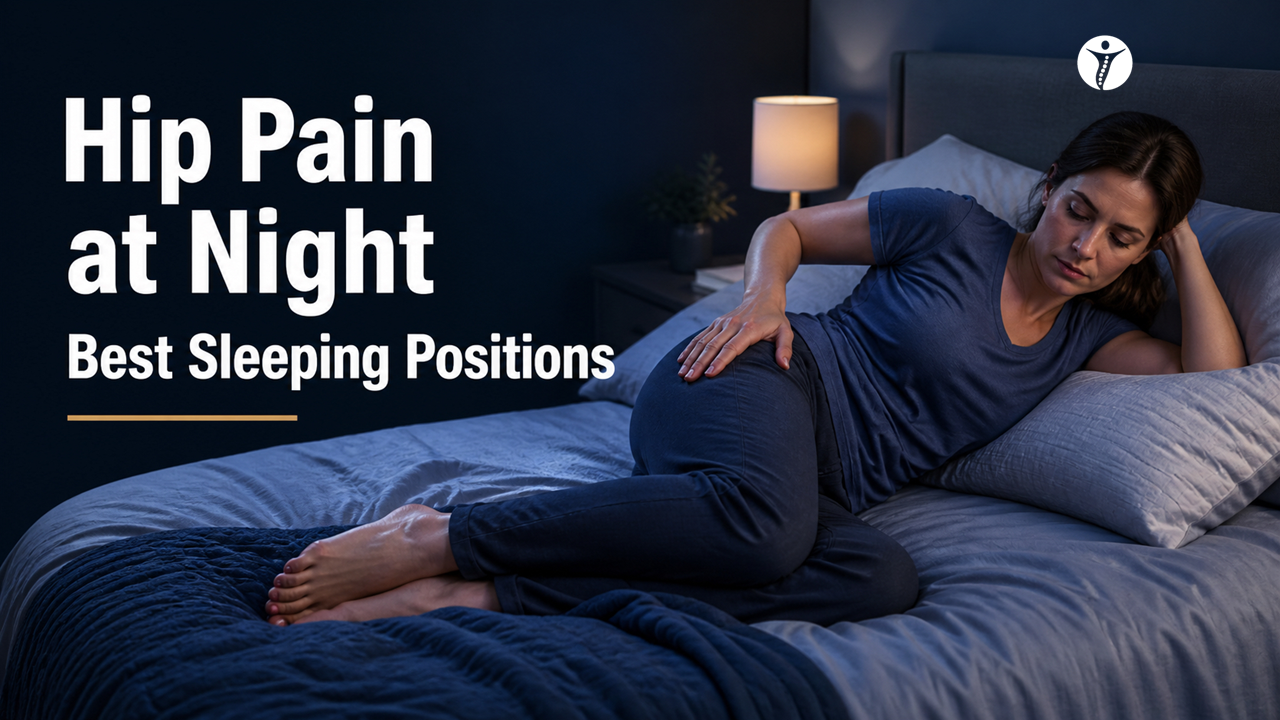
    Infographic showing best sleeping positions for hip pain, including side sleeping with pillow between knees and back sleeping with pillow under knees.
    Image 1: The right setup reduces pressure and lets the hip calm down overnight.
    Side-sleep pressure often drives outer hip pain
    Pillows can stack hips and reduce compression fast
    If pain travels down leg or feels nerve-y, consider back/nerve pattern

    If your hip hurts at night, the goal is to reduce pressure, keep the pelvis/hips aligned, and stop “testing” the painful position for hours. If pain persists or keeps returning, start with Hip Pain Treatment. If symptoms travel down the leg, compare patterns here: Hip Pain vs. Sciatica vs. Low Back Pain.

    • Best positions + pillow setups you can use tonight
    • Pattern clues (outer hip vs groin vs sciatica-like)
    • Clear “when to worry” guidance

    Educational only. Not medical advice. Seek urgent evaluation for severe/worsening symptoms or red flags.

    Quick Answer (Do This Tonight)

    Hip pain is often worse at night because the hip is compressed for long periods (especially side sleeping), you move less, and irritated tissues become more sensitive. The fastest fix is usually reducing pressure and stacking the hips with pillows.

    Side sleeping pillow setup for hip pain, using a pillow between the knees to keep hips aligned and reduce pressure.
    Image 2: Side sleepers—pillow between knees + small alignment tweaks can change sleep fast.

    Tonight checklist (fast wins)

    • Side sleepers: put a pillow between knees (thick enough to keep top knee from dropping)
    • Back sleepers: pillow under knees to reduce hip/back tension
    • Avoid: sleeping directly on the painful outer hip for long stretches
    • Micro-roll: if side sleeping, roll slightly forward (unloads the side of hip for many people)
    • Comfort add-on: short heat or ice session before bed—use what helps you sleep

    Next-day rule

    If your hip feels the same or better the next morning, you chose a good setup. If it’s worse, adjust the pillow thickness and avoid the painful side longer.

    Best Sleeping Positions for Hip Pain

    Pick the option that reduces pressure and keeps your pelvis/hips aligned.

    Side sleeping (most common)

    • Key goal: keep hips stacked (don’t let top knee drop)
    • Best setup: pillow between knees + slight forward roll
    • Avoid: long periods directly on painful outer hip

    Back sleeping (often best for pressure relief)

    • Best setup: pillow under knees
    • Reduces pull on hips and low back for many people
    • If one hip feels “pulled,” try a small towel under that thigh

    Stomach sleeping (not ideal, but if you must)

    • Stomach sleeping often increases hip rotation and low back extension
    • If you must: small pillow under pelvis to reduce extension
    • Try to avoid hard head rotation all night

    If you keep rolling onto the painful side

    • Use a “backstop” pillow behind you
    • Or place a pillow in front (hug it) to keep you slightly forward
    • Goal: reduce hours of direct compression

    Pillow Setup (The Part That Makes It Work)

    Most “best sleeping positions” advice fails because the pillow thickness doesn’t match your body.

    Pillow between knees: how thick?

    • Thick enough that the top knee doesn’t drop toward the bed
    • If the pillow is too thin, the top hip falls inward and increases compression
    • If too thick, you may feel strain in the low back—adjust down

    Optional: “waist pillow” for side sleepers

    • If you feel your spine is “hanging,” add a small pillow at the waist
    • This keeps spine/pelvis more neutral and can reduce hip irritation

    Back sleepers: knee bolster height

    A pillow under knees should feel like it takes tension off the hip and low back. If it feels cramped, lower the bolster height.

    Pattern Clues (How to Tell What’s Driving It)

    Hip pain at night can come from different “buckets.” Use location + symptoms to choose the right direction.

    Outer hip pain (side of hip) — often pressure-driven

    If pain is on the outside of the hip and is worse when lying directly on that side, it often fits a glute tendon / bursitis-type irritation pattern. The best first step is reducing compression and building hip tolerance over time.

    Groin/front hip pain

    Groin/front pain can be more hip-joint or hip flexor–related, and may respond differently than outer hip compression. If this is persistent, an exam helps clarify the driver.

    Buttock/SI-region pain

    Pain more in the buttock or SI area can be a different pathway (pelvis/SI/low back mechanics). If symptoms behave like back referral, compare patterns here: Hip Pain vs. Sciatica vs. Low Back Pain.

    If pain travels down the leg or feels nerve-y

    Tingling, numbness, burning, or pain that travels below the knee can suggest a nerve/back pattern rather than “just the hip.” Consider evaluation and review Sciatica Treatment.

    What to Avoid (Common Traps)

    These often keep night pain stuck in a loop.

    • Sleeping directly on the painful outer hip for hours
    • Side sleeping with knees together (no pillow) → hip collapse inward
    • Over-testing the painful position night after night
    • Forcing aggressive stretches into sharp pain before bed

    When to Worry (Red Flags)

    Get checked promptly if any of these are present.

    • Unable to bear weight or sudden severe pain
    • Major trauma (fall, collision)
    • Fever or a hot/red joint
    • Rapidly worsening pain that doesn’t change with position
    • Progressive weakness or new/worsening numbness/tingling down the leg
    • Night pain with systemic symptoms (unexplained weight loss/night sweats) — get evaluated

    If you’re unsure, start with Contact & Location and we’ll guide you.

    Not urgent, but smart to book

    • Sleep disrupted for > 1–2 weeks
    • Pain progressing week to week
    • Recurring cycles that return when you resume normal activity

    Start here: Hip Pain Treatment.

    Want a Hip Plan That Improves Sleep and Holds Up?

    We’ll identify your pattern (outer hip compression, hip joint, SI/low back referral) and build a plan that reduces night pain and improves tolerance.

    Hip Pain at Night FAQs

    Quick answers—including sleeping positions and “when to worry.”

    Why is hip pain worse at night?
    Night pain is often worse because the hip is compressed for long periods (especially side sleeping), you move less, and irritated tissues become more sensitive.
    What is the best sleeping position for hip pain?
    Many people do best on their back with a pillow under the knees, or on their side with a pillow between the knees to keep hips stacked. Avoid long periods directly on the painful outer hip.
    How should side sleepers position pillows?
    Use a pillow between the knees thick enough to keep the top knee from dropping. Some people also benefit from a small pillow at the waist for neutral alignment.
    Could this be bursitis or glute tendon pain?
    Outer hip pain that’s worse when lying on that side often fits a glute tendon/bursitis-type pattern. Reducing compression and improving hip tolerance usually helps.
    Could this be sciatica or low back related?
    Yes. Pain that travels down the leg, includes tingling/numbness, or feels nerve-y can suggest a back/nerve pattern. Compare patterns here: Hip vs Sciatica vs Low Back.
    Should I use heat or ice?
    Either can help. Many people prefer heat for tightness and ice for sharp irritation. Use what improves comfort and sleep.
    How long does it take to improve?
    Many people notice better sleep within days when pressure is reduced. Longer-standing patterns often improve over weeks with a plan that addresses strength, load, and mechanics.
    When should I worry and get checked?
    Get checked promptly for inability to bear weight, major trauma, fever/hot red joint, rapidly worsening pain, progressive weakness, or new/worsening numbness or tingling down the leg.

  • Hip Pain vs. Sciatica vs. Low Back Pain: How to Tell (and What to Do First)

    Hip Pain vs. Sciatica vs. Low Back Pain: How to Tell (and What to Do First)

    HIP PAIN · SCIATICA · LOW BACK · DECISION GUIDE · LOGANSPORT, IN

    Pattern checks (not guesswork) Clear red flags + when to image Conservative first steps for each bucket

    Hip Pain vs. Sciatica vs. Low Back Pain: How to Tell (and What to Do First)

    Same area, different drivers. The best first step depends on where it hurts, what triggers it, and whether symptoms travel.

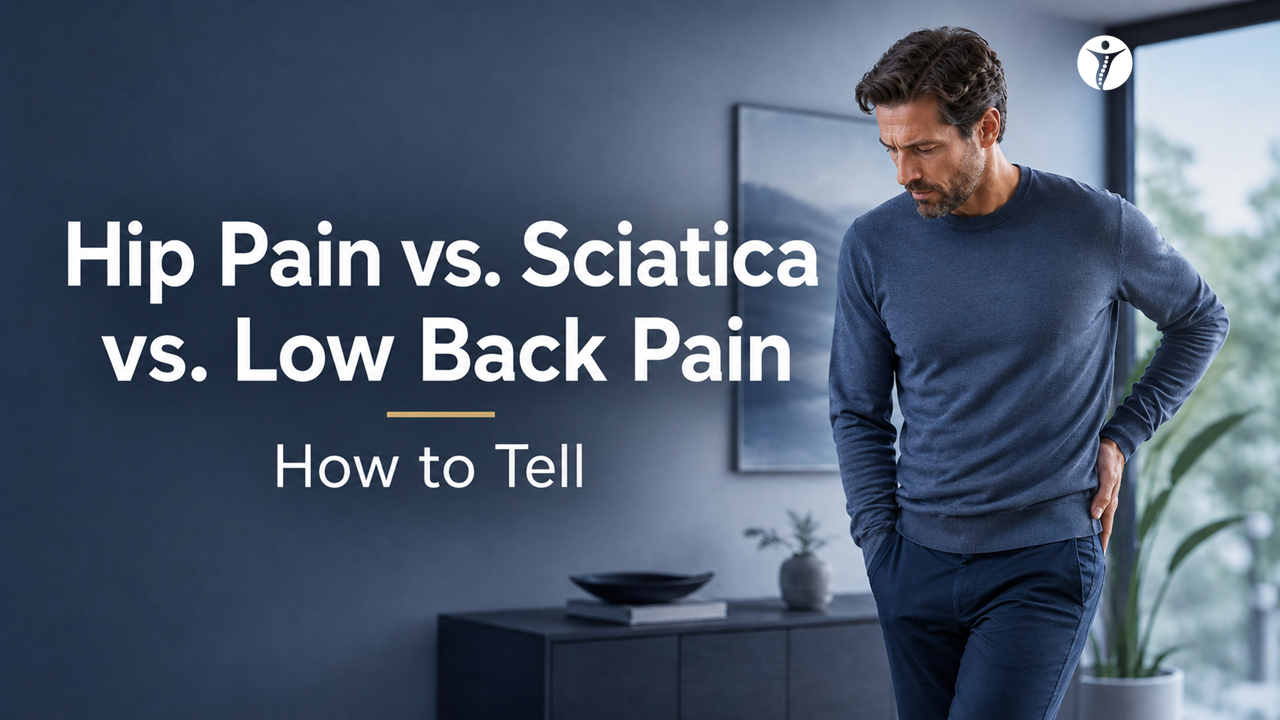
    Infographic comparing hip pain, sciatica, and low back pain patterns, highlighting location, triggers, and whether symptoms travel below the knee.
    Image 1: Three common patterns—use location, triggers, and “does it travel?” to self-sort.
    Hip pain often = groin/side pain with hip-specific triggers
    Sciatica often = leg symptoms + nerve-y signs (often below knee)
    Low back pain often stays local and changes with posture/movement

    If you’re not sure whether your pain is hip-driven, back-driven, or nerve-driven, you’re not alone—these overlap constantly. This guide helps you self-sort the dominant pattern and choose a safe first step. Service overview links: Hip Pain Treatment, Sciatica Treatment, Low Back Pain Treatment.

    • 60-second self-check + comparison table
    • Three pattern buckets + “what to do first” ladders
    • Clear “when to worry” guidance

    Educational only. Not medical advice. Patterns overlap—an exam confirms the driver.

    Quick Answer (The Biggest Clues)

    Hip pain is often felt in the groin or side of hip and flares with hip-specific tasks (shoes, car, stairs). Sciatica often includes leg symptoms (often below the knee) and may include tingling/numbness/weakness. Low back pain is more often centered in the lumbar area and changes with posture and movement.

    Supporting visual emphasizing that symptoms traveling below the knee often indicates a nerve-driven pattern rather than isolated hip pain.
    Image 2: The biggest clue: symptoms traveling below the knee often points to a nerve pattern.

    One rule that prevents most wrong turns

    If symptoms are traveling below the knee or feel nerve-y (tingling/numbness/weakness), treat it like a nerve pattern first and get evaluated if it’s worsening.

    60-Second Self-Check (3-Way Sorter)

    Answer quickly. You’re looking for the dominant pattern.

    1) Where is it strongest?
    Groin/side hip? Low back? Buttock?
    2) Does it travel below the knee?
    If yes, sciatic/nerve pattern is more likely.
    3) Any tingling, numbness, or weakness?
    If yes, nerve pathway deserves attention.
    4) Worse with sitting?
    Often points toward lumbar/nerve patterns.
    5) Worse putting on socks/shoes or getting in/out of car?
    Often points toward hip-driven patterns.
    6) Worse with cough/sneeze/straining?
    Can point toward nerve irritation in some cases.

    Interpretation

    • Mostly hip clues: groin/side pain + hip tasks trigger it.
    • Mostly nerve clues: travels below knee and/or tingling/numbness/weakness.
    • Mostly low back clues: centered low back pain that changes with movement/posture.

    Comparison Table (Fast, Skimmable)

    This table keeps it simple and prevents “wrong-plan” mistakes.

    Clue Hip Pain Pattern Sciatica Pattern Low Back Pattern
    Common location Groin/side hip (sometimes deep ache) Buttock + leg symptoms (often below knee) Centered low back
    Common triggers Socks/shoes, car, stairs, side sleeping Sitting/bending, certain positions, cough/sneeze sometimes Bending, sitting, standing, lifting
    Does it travel? Often thigh, less often below knee Often below knee Usually stays local (can refer to buttock)
    Nerve-y signs Less common More common (tingling/numbness/weakness) Usually none unless nerve involved
    Best first step Calm hip irritability + restore motion + build strength Stop provocation + positions that centralize + staged return Reduce spike + gentle movement + strength progression
    When to evaluate sooner Severe worsening or inability to bear weight Progressive weakness, bowel/bladder changes, severe nerve symptoms Worsening neuro signs, trauma, systemic illness

    Hip Pain Pattern (Hip-Driven)

    Hip pain is often groin/side pain that’s provoked by hip-specific tasks.

    Common clues

    • Groin pain or deep ache in the hip
    • Side-of-hip pain (especially with side sleeping)
    • Worse with socks/shoes, car in/out, stairs

    Service overview: Hip Pain Treatment.

    What usually helps first

    • Short 7–10 day “calm the spike” window (avoid the worst provokers)
    • Gentle range + walking tolerance
    • Progressive hip/glute strength (pain-safe)

    Night pain? Read: Hip Pain at Night: Best Sleeping Positions.

    Sciatica Pattern (Nerve-Driven)

    Sciatica often includes leg symptoms (often below the knee) and can feel sharp, burning, or electric.

    Common clues

    • Pain traveling into the leg, often below the knee
    • Tingling, numbness, or weakness
    • Often worse with sitting or certain bending positions

    Service overview: Sciatica Treatment.

    What usually helps first

    • Stop repeated provocation (don’t “test” it all day)
    • Walk and use positions that reduce leg symptoms
    • Staged return + strength progression

    Read next: Best Sleeping Positions for Sciatica and Sciatica vs. Piriformis Syndrome.

    Low Back Pain Pattern (Lumbar-Driven)

    Low back pain often stays local and changes with posture, bending, or lifting.

    Common clues

    • Centered low back pain (may refer to buttock)
    • Changes with bending, sitting, standing, lifting
    • Often improves with gentle movement over time

    Service overview: Low Back Pain Treatment.

    What usually helps first

    • Reduce the spike (avoid repeated deep bending early)
    • Gentle movement (short walks) + pain-safe positions
    • Progressive strength and hinge strategy

    Read next: Low Back Pain Causes (and What Helps).

    What to Do First (3 Ladders)

    Pick the ladder that fits your dominant pattern.

    Hip ladder

    1. Calm the spike: avoid the worst hip provokers 7–10 days
    2. Walk: short, frequent walks (tolerance building)
    3. Restore motion: gentle range (no forcing)
    4. Build strength: glute/hip progression

    Sciatica ladder

    1. Stop provocation: avoid positions that worsen leg symptoms
    2. Centralize: choose positions that reduce leg pain (walk often helps)
    3. Stage return: gradual reintroduction of bending/sitting tolerance
    4. Evaluate if worsening or neurologic signs appear

    Low back ladder

    1. Reduce spike: stop repeated painful “tests”
    2. Gentle motion: short walks + pain-safe positions
    3. Strength: progressive trunk/hip strength + hinge strategy
    4. Return: graded return to work/lifting

    Centralization = often a good sign

    If leg symptoms move up and become more local (less traveling), that often suggests you’re moving in the right direction. If symptoms spread farther down the leg, reassess.

    When to Worry (Red Flags)

    Seek urgent evaluation if any of these are present.

    • Progressive weakness (foot drop, worsening leg weakness)
    • Bowel/bladder changes or saddle numbness
    • Fever or feeling very unwell with back/hip pain
    • Major trauma (fall, car accident)
    • Severe night pain that keeps escalating
    • Rapidly worsening symptoms day-to-day

    If you’re unsure, start with Contact & Location and we’ll guide you.

    Want a Clear Answer (Not a Guess)?

    We’ll confirm the driver (hip vs back vs nerve), calm irritation, and build a step-by-step plan that holds up.

    Hip vs Sciatica vs Low Back FAQs

    Quick answers—including the “does it travel?” clue.

    How do I know if it’s sciatica?
    Sciatica often includes pain traveling into the leg (especially below the knee) and may include tingling, numbness, or weakness. Symptoms are often provoked by certain positions (sitting/bending) and may improve with positions that reduce nerve irritation.
    Can hip pain mimic sciatica?
    Yes. Hip joint or glute/tendon pain can refer into the thigh and feel “sciatica-like,” but true sciatica more often includes nerve symptoms and pain traveling below the knee.
    How do I tell hip pain vs low back pain?
    Hip pain is often felt in the groin/side hip and is provoked by hip-specific tasks (car, shoes, stairs). Low back pain is more often centered in the lumbar area and changes with bending, sitting, or standing.
    What’s the safest first step if I’m not sure?
    Start with a short 7–10 day “calm the spike” window: reduce provoking positions, keep gentle walking, and avoid repeated testing. If symptoms travel below the knee, include tingling/numbness, or worsen, get evaluated.
    Do I need imaging?
    Often not initially if there are no red flags and symptoms are improving. Imaging is more important with major trauma, progressive weakness, bowel/bladder changes, fever, severe night pain that escalates, or persistent/worsening symptoms.
    What sleeping positions help sciatica?
    Many people do best with side-lying with a pillow between knees or on the back with knees supported. The best position is the one that reduces leg symptoms and allows sleep.
    How long does it take to improve?
    Many mechanical patterns improve over a few weeks with the right plan. Nerve-driven symptoms can take longer and improve best with staged progression and avoiding repeated provocation.
    When should I worry and get checked urgently?
    Seek urgent evaluation for progressive weakness, new bowel/bladder changes or saddle numbness, fever, major trauma, severe/worsening night pain, or significant neurologic symptoms.
  • Hip Pain in Logansport, IN: 6 Common Causes (and What Helps)

    Hip Pain in Logansport, IN: 6 Common Causes (and What Helps)

    HIP PAIN · PATIENT EDUCATION · LOGANSPORT, IN

    Evidence-informed, conservative-first care Pattern clues (groin vs side vs buttock) Clear “when to worry” guidance

    Hip Pain in Logansport, IN: 6 Common Causes (and What Helps)

    Hip pain isn’t always “tight hip flexors.” Match the plan to the pattern—don’t guess.

    Infographic showing hip pain patterns by location (groin/front, side hip, buttock/back) and common causes with next steps.
    Image 1: Hip pain patterns—groin vs side hip vs buttock/back—plus what helps.
    Groin pain often points hip-joint side
    Side hip pain often points glute/tendon overload
    Buttock + leg symptoms may be back/nerve pattern

    Hip pain is one of the most common problems we see in Logansport—runners, lifters, workers on concrete, and anyone whose activity volume recently increased. If you want the service overview, start with Hip Pain Treatment. If you’re unsure whether it’s hip vs back vs nerve, start with Hip vs Sciatica vs Low Back (How to Tell).

    • 4 big clues to narrow the pattern fast
    • 6 common causes + what helps first
    • Clear “when to worry” guidance

    Educational only. Not medical advice. Patterns overlap—an exam confirms the driver.

    Quick Answer (If You Only Read One Section)

    Most hip pain improves when you reduce the spike (the movement/position that flares it), then rebuild hip/glute capacity with a staged plan. The best clue is where it hurts: groin vs side hip vs buttock/back.

    Supporting visual reinforcing hip pain pattern clues and conservative first steps: load control and strength progression.
    Image 2: Most hip pain improves with load control + strength progression—match the plan to the pattern.

    Three “do this first” steps

    • Next-day rule: you should feel the same or better the next day (mild soreness is okay).
    • Calm the spike: reduce the worst provokers for 7–10 days (don’t test it all day).
    • Build capacity: progressive glute/hip strength + walking tolerance.

    Start Here: 4 “Big Clues” That Narrow Hip Pain Fast

    Use these clues to decide which cause to read first—then confirm the driver with an exam if symptoms persist.

    1) Where does it hurt most?
    Groin/front? Side hip? Buttock/back of hip?
    2) What triggers it most?
    Shoes/socks, car in/out, stairs, side sleeping, walking distance, sitting?
    3) Does it travel below the knee or feel nerve-y?
    Tingling/numbness/weakness suggests a nerve pathway—evaluate if worsening.
    4) Is motion truly limited?
    If hip motion feels blocked (not just painful), the plan may differ.

    Quick routing

    • Groin pain + stiffness: consider hip joint irritation patterns.
    • Side hip pain + night pain: consider glute tendon overload patterns.
    • Buttock + leg symptoms: consider back/nerve patterns.

    6 Common Causes of Hip Pain (and What Usually Helps)

    These are the most common hip pain patterns we see around Logansport and Cass County.

    1) Hip joint irritation / arthritis-type pattern

    Clue: groin pain and stiffness, worse with deep hip flexion and after inactivity.

    • Helps first: walking tolerance + gentle range + staged strength
    • Evaluate if inability to bear weight or rapidly worsening pain

    2) Glute med/min tendon overload (side hip pain)

    Clue: side-of-hip pain, often worse with side sleeping, stairs, or single-leg loading.

    3) “Bursitis-like” lateral hip pain pattern (often overlaps with #2)

    Clue: tender lateral hip, pain with direct pressure and walking volume spikes.

    • Helps first: reduce direct compression + build glute capacity gradually
    • Note: many “bursitis” cases are really tendon overload + compression sensitivity.

    4) Hip flexor / adductor strain (front/groin)

    Clue: pain with lifting the knee, sprinting, getting up from deep positions, or sudden activity spikes.

    • Helps first: calm the spike + graded strengthening (not aggressive stretching early)
    • Evaluate if bruising, major weakness, or severe pain after an injury

    5) SI joint or low back referral masquerading as hip pain

    Clue: buttock/back-of-hip pain that changes with posture, bending, or lifting.

    6) Sciatica / nerve referral (hip/buttock + leg symptoms)

    Clue: symptoms traveling into the leg (often below the knee) with tingling/numbness/weakness.

    What Usually Helps (The Universal Hip Plan)

    This approach works across most non-emergency hip pain patterns.

    1) Use the next-day rule

    • Same or better next day = okay
    • Mild soreness = okay
    • Worse next day (especially with limp) = too much → scale down

    2) Calm the spike (7–10 days)

    • Temporarily reduce the movements/positions that flare you most
    • Stop daily “tests” of the painful motion
    • Use short, frequent walks as tolerated

    3) Build capacity (glute/hip strength)

    • Progressive glute/hip strength is the long-term solution for many patterns
    • Progress volume before intensity
    • Consistency beats occasional hard sessions

    If you’re not sure what bucket you’re in

    Start here: Hip Pain vs Sciatica vs Low Back (How to Tell).

    When to Worry (Red Flags)

    Get checked promptly if any of these are present.

    • Unable to bear weight or severe worsening pain
    • Major trauma (fall, collision)
    • Fever or a hot/red swollen joint
    • Progressive weakness or worsening numbness/tingling
    • Bowel/bladder changes or saddle numbness
    • Severe night pain that keeps escalating

    If you’re unsure, start with Contact & Location and we’ll guide you.

    Not urgent, but smart to book

    • Persistent symptoms beyond 2–3 weeks despite a smart plan
    • Recurring flare cycles
    • Significant limp
    • Symptoms traveling below the knee

    Want a Hip Plan That Actually Holds?

    We’ll identify your pattern, calm irritation, and build a step-by-step plan that holds up for work, sleep, and training.

    Hip Pain FAQs

    Quick answers—including “how to tell” and “when to worry.”

    What is the most common cause of hip pain?
    Common causes include hip joint irritation patterns, side-hip glute tendon overload, and referral patterns from the low back. The best clue is where it hurts and what triggers it.
    How do I tell hip pain vs sciatica vs low back pain?
    Hip pain is often groin/side pain provoked by hip tasks (shoes, car, stairs). Sciatica more often includes leg symptoms and nerve-y signs (often below the knee). Low back pain is more centered in the lumbar area and changes with bending, sitting, or standing.
    Why does side hip pain hurt at night?
    Side sleeping compresses irritated glute tendons/bursa-like tissues. A pillow between knees and changing positions can reduce compression and help sleep.
    Do I need imaging for hip pain?
    Often not initially if there are no red flags and you’re improving. Imaging is more important with major trauma, inability to bear weight, fever/hot red joint, progressive weakness/numbness, or persistent/worsening symptoms.
    Should I keep walking if my hip hurts?
    Often yes—within tolerance. Short, frequent walks usually help more than complete rest. If walking causes a limp that worsens or pain escalates sharply, scale back and get evaluated.
    What exercises help hip pain most?
    Most people benefit from a staged progression that builds glute/hip strength and improves tolerance. The best plan matches your pain pattern and avoids repeated provocation early on.
    How long does hip pain take to improve?
    Many mechanical and overload patterns improve over a few weeks with consistent load management and strengthening. Longer-standing patterns can take longer but still respond well to a staged plan.
    When should I worry and get checked?
    Get checked promptly for inability to bear weight, major trauma, fever/hot red joint, rapidly worsening pain, progressive weakness/numbness, severe night pain that escalates, or symptoms traveling below the knee.

  • Best Sleeping Positions for Shoulder Pain (Plus What to Avoid)

    SHOULDER PAIN · PATIENT EDUCATION · LOGANSPORT, IN

    Best Sleeping Positions for Shoulder Pain (Plus What to Avoid)

    Night pain is usually a position + compression problem. Fix the setup—don’t just “power through.”

    Back sleeping with arm support is often the most shoulder-friendly
    Side sleeping works best when you hug a pillow (prevents the shoulder from rolling forward)
    Sleeping on the painful shoulder (or with the arm overhead) often flares rotator cuff/impingement patterns

    Shoulder pain that’s worse at night is extremely common — and usually fixable. Most “night shoulder pain” is driven by compression, poor shoulder position, or the arm drifting into a cranky angle for hours. This guide shows the best sleeping positions, pillow setups, what to avoid, and when to get checked. If your symptoms persist or you want a clear plan, start with our Shoulder Pain Treatment page.

    • Goal: keep the shoulder “stacked” and supported—not rolled forward or compressed
    • Pillow placement matters more than the “perfect mattress”
    • Red flags + “when to worry” included below

    Educational only. Not medical advice.

    Start Here: Why Shoulder Pain Gets Worse at Night

    Most nighttime shoulder pain comes from one (or more) of these drivers.

    1) Compression for hours

    Sleeping on the sore shoulder (or letting it roll forward) increases pressure on irritated tissues.

    2) The arm drifts into a “bad angle”

    Overhead positions, arm across the body, or the shoulder collapsing forward can aggravate rotator cuff or impingement patterns.

    3) Reduced movement = more stiffness

    When you don’t move for hours, stiff joints and sensitive tendons can feel worse when you finally shift positions.

    4) Inflammation or tendon irritation can peak at night

    Some cases are more “inflammatory,” but positioning is still the #1 fix you can control immediately.

    The Best Sleeping Positions for Shoulder Pain

    Use the setup that keeps the shoulder supported and neutral.

    Option 1: Sleep on your back + support the painful arm

    This is often the most shoulder-friendly option because it avoids compression and reduces “rolling forward.” Place a pillow under the forearm and hand of the painful side so the shoulder stays supported.

    • Pillow setup: one pillow under the forearm/hand (elbow slightly away from the body)
    • Extra win: small towel roll under the upper arm if the shoulder feels “pulled forward”
    • Avoid: arm overhead or tucked hard under your head

    Option 2: Sleep on the non-painful side + hug a pillow

    Side sleeping can work great if you prevent the painful shoulder from rolling forward. Hugging a pillow supports the arm and keeps the shoulder in a safer position.

    • Pillow setup: hug a pillow so the painful arm rests on it (not across your chest)
    • Keep it stacked: shoulder stays “on top,” not dumped forward
    • Hip alignment: optional pillow between knees so your trunk doesn’t twist

    Option 3: Reclined (for severe night pain)

    If flat positions are unbearable, a recliner or adjustable bed can reduce shoulder strain temporarily. Support the elbow and forearm with a small pillow so the shoulder isn’t hanging.

    • Best for: acute flare-ups, severe impingement patterns, or when lying flat is impossible
    • Goal: calm symptoms, then transition back to back/side sleeping as tolerated

    If your shoulder pain is linked to lifting or overhead work, also read Lifting Shoulder Pain: 5 Common Mistakes (and Fixes).

    What to Avoid (Common Sleep Mistakes That Flare Shoulders)

    If you fix these, many people sleep better within a few nights.

    1) Sleeping on the painful shoulder

    Compression for hours is a classic reason rotator cuff and impingement patterns feel worse at night.

    2) Arm overhead (“goalpost” or under the pillow)

    This position often irritates the front/outer shoulder and can trigger pinching or tendon pain.

    3) Arm across your chest (shoulder rolls forward)

    Common in side sleepers. Fix it by hugging a pillow to keep the shoulder supported and stacked.

    4) Too many pillows under your head (neck + shoulder tension)

    Excess neck flexion can increase upper trap/neck tension, feeding shoulder discomfort. Consider a neutral neck setup.

    Want to Sleep Without Shoulder Pain?

    If you’ve tried position changes and sleep is still disrupted, an exam can clarify the driver (rotator cuff vs. impingement vs. frozen shoulder patterns) and give you a plan that actually holds up. See Rotator Cuff vs. Impingement vs. Frozen Shoulder.

    When to Worry (Red Flags)

    Get checked promptly if any of these are true.

    • Sudden weakness after an injury (can’t raise the arm like before)
    • Visible deformity, major swelling, or significant bruising
    • Numbness/tingling that’s progressive or traveling down the arm
    • Fever or a hot/red swollen joint
    • Night pain that is rapidly worsening or not improving with position changes

    Not sure? Start with Contact & Location and we’ll guide next steps.

    Shoulder Pain Sleeping FAQs

    Quick answers—including “when to worry.”

    What is the best sleeping position for shoulder pain?
    Most people do best on their back with the painful arm supported, or on the non-painful side while hugging a pillow to keep the shoulder from rolling forward.
    What sleeping position makes shoulder pain worse?
    Sleeping directly on the painful shoulder or letting the arm drift overhead or across your chest often increases compression and irritation.
    Why does shoulder pain get worse at night?
    Night pain is often driven by sustained compression and poor positioning for hours. Reduced movement can also increase stiffness and sensitivity.
    How long should I try pillow changes before getting evaluated?
    If you’re not improving in 7–14 days, if sleep is consistently disrupted, or if symptoms are worsening, an exam can clarify the driver and the safest plan.
    Can rotator cuff issues cause night pain?
    Yes. Rotator cuff irritation and impingement patterns commonly worsen at night—especially when the shoulder is compressed or positioned overhead or forward.
    When should I worry about shoulder pain at night?
    Get checked promptly for significant weakness after injury, deformity, progressive numbness/tingling, fever, major swelling/bruising, or rapidly worsening night pain.

  • Rotator Cuff vs. Impingement vs. Frozen Shoulder: How to Tell (and What to Do First)

    Rotator Cuff vs. Impingement vs. Frozen Shoulder: How to Tell (and What to Do First)

    SHOULDER PAIN · DECISION GUIDE · LOGANSPORT, IN

    Evidence-informed, conservative care We check motion + strength + scapula mechanics Clear “what to do first” guidance

    Rotator Cuff vs. Impingement vs. Frozen Shoulder: How to Tell (and What to Do First)

    They’re commonly confused — but the best first step differs.

    Decision guide infographic comparing rotator cuff irritation, impingement-type pain, and frozen shoulder with key signs and what to do first.
    Image 1: A quick decision guide to narrow which bucket fits best and what to do first.
    Frozen shoulder: stiffness + progressive loss of motion (blocked)
    Impingement-type: painful arc with overhead activity + mechanics/load
    Rotator cuff: tendon overload—pain with lifting/ lowering + common night pain

    If you’ve been told “it’s probably your rotator cuff,” you’re not alone. Use these pattern checks to narrow what’s most likely, then pick the safest first step. For the broader overview, see Shoulder Pain: 7 Common Causes and the care page Shoulder Pain Treatment.

    • Quick answer + table + first-step plan
    • Designed for lifters, workers, and busy humans
    • Clear “when to worry” red flags included below

    Educational only. Not medical advice. Seek urgent care for severe/worsening symptoms or red flags.

    Quick Answer (If You Only Read One Section)

    Frozen shoulder is dominated by stiffness and a “blocked” feeling. Impingement-type pain often has a painful arc with overhead activity. Rotator cuff irritation behaves like tendon overload—pain with lifting/lowering and common night pain.

    Supporting shoulder visual used alongside the decision guide to reinforce the comparison and first-step plan.
    Image 2: Supporting visual for the comparison and action ladder.

    Best first step (simple rule)

    If range of motion is progressively disappearing, treat it like a stiffness pathway. If motion is mostly there but overhead is cranky, treat it like mechanics + load. If lifting/lowering is painful (and night pain is common), treat it like tendon overload.

    Comparison Table (Fast, Skimmable)

    This isn’t a diagnosis — it’s a way to choose the right direction and avoid the wrong plan.

    Feature Frozen Shoulder Impingement-Type Pain Rotator Cuff Irritation
    Dominant feel Stiff + blocked Pinch/painful arc overhead Tendon overload (lift/lower pain)
    Range of motion True loss (esp. external rotation; behind-back) Often available but painful in certain angles Often mostly available; strength tests can hurt
    Classic trigger Reaching behind back; rotating outward Repetitive overhead work; certain angles Lifting away from body; lowering from overhead
    Night pain Common Can happen Common
    Best first step Staged mobility + irritation management Scapula mechanics + mobility + graded strength Load management + tendon-focused strengthening
    What NOT to do Force sharp stretches Keep testing painful overhead reps daily Keep pressing through pain without modifying load

    Quick Pattern Checks

    Use these to narrow the bucket — then confirm with an exam if symptoms persist.

    1

    Frozen Shoulder (stiff + blocked)

    Key sign: you feel “stuck,” especially rotating outward and reaching behind your back.

    First step: consistent, low-intensity mobility (not aggressive forcing) + a staged plan.

    2

    Impingement-Type (painful arc)

    Key sign: pain through a slice of the lift (often 60–120°), worse with repeated overhead work.

    First step: scapular mechanics + thoracic mobility + gradual strengthening.

    3

    Rotator Cuff Irritation (tendon overload)

    Key sign: pain/weakness with lifting away from the body and lowering the arm; night pain is common.

    First step: load management + tendon-strength progression + technique cleanup.

    Not sure? Here’s the safest default

    Stop repeatedly forcing painful overhead reps for a week, keep pain-safe motion daily, and choose a plan matched to your best-fit bucket. If you’re losing motion week-to-week, treat it as a stiffness pathway and get evaluated.

    What to Do First (Action Ladder)

    Simple steps you can follow without guessing.

    First 72 hours

    • Reduce the one movement that reliably spikes pain (usually overhead / deep pressing)
    • Keep pain-safe motion (don’t immobilize)
    • Stop “testing” the painful angle multiple times per day

    Next 7–14 days

    • If you suspect rotator cuff overload: bias pulling/upper back work and build pain-safe strength
    • If you suspect impingement-type: add thoracic mobility + scapular control and adjust pressing angles
    • If you suspect frozen shoulder: daily staged mobility without forcing sharp pain

    Weeks 2–6

    • Progress range first, then strength
    • Reintroduce overhead gradually only when tolerance improves
    • For lifting-related issues, read: Lifting Shoulder Pain Fixes

    When imaging is more reasonable

    • Significant trauma + major weakness, deformity, or severe swelling/bruising
    • Progressive loss of motion week-to-week
    • Stalled progress despite a smart plan and good adherence

    Want a Clear Answer Fast?

    We’ll test range of motion, strength, and shoulder blade mechanics to pinpoint the driver and guide your plan.

    When to Worry (Red Flags)

    Get urgent evaluation if any of these are present.

    • Deformity after injury, suspected dislocation/fracture
    • Inability to lift the arm or sudden major weakness after a pop/injury
    • Sudden severe swelling/bruising
    • Fever with a hot/red shoulder
    • Chest pain/shortness of breath or concerning systemic symptoms
    • New numbness/weakness down the arm

    If you’re unsure, start with Contact & Location and we’ll guide you.

    Rotator Cuff vs. Impingement vs. Frozen Shoulder FAQs

    Quick answers—including “when to worry.”

    What’s the easiest sign of frozen shoulder?
    A progressive loss of range of motion—especially external rotation—where the shoulder feels stiff and blocked, not just painful.
    What does impingement-type pain feel like?
    Often a painful arc when lifting the arm, worse with repetitive overhead work. It often improves when mechanics and mobility are addressed.
    How do I know if it’s rotator cuff irritation?
    Often pain with lifting away from the body or lowering from overhead; night pain is common.
    When should I worry about a tear?
    Seek evaluation if you had a sudden injury with a pop, bruising, significant weakness, or you can’t lift the arm. Urgent care is appropriate for deformity or severe swelling.
    Do I need imaging?
    Not always. Many mechanical shoulder problems improve with the right plan. Imaging is more appropriate with major trauma, big weakness, progressive loss of motion, or stalled progress.
    Why is it worse at night?
    Side-sleep compression and poor support can spike symptoms, and some irritation/stiffness patterns increase night pain.
    What’s the best first step if I’m unsure?
    Stop repeatedly forcing painful overhead movement and get an exam that checks motion, strength, and scapular mechanics.
    When should I worry and get urgent care?
    Urgent evaluation is needed for deformity after injury, inability to lift the arm, sudden severe swelling/bruising, fever with a hot/red joint, chest pain/shortness of breath, or new numbness/weakness down the arm.
  • Shoulder Pain in Logansport, IN: 7 Common Causes (and What Helps)

    SHOULDER PAIN · PILLAR GUIDE · LOGANSPORT, IN

    Evidence-informed, conservative care Doctor-led exam to find the true driver Logansport, IN · Patient-first

    Shoulder Pain in Logansport, IN: 7 Common Causes (and What Helps)

    Most shoulder pain follows a pattern. Match the plan to the pattern—don’t guess.

    Shoulder pain patterns infographic showing common drivers such as rotator cuff irritation, impingement patterns, frozen shoulder stiffness, AC joint pain, biceps/labrum irritation, neck referral, and overload spikes.
    Image 1: Compare the most common shoulder pain patterns. Patterns can overlap—an exam confirms the primary driver.
    Overhead pain often points to rotator cuff / overload patterns
    Loss of motion that worsens week-to-week suggests a stiffness pathway
    Neck + shoulder blade mechanics often drive “shoulder” symptoms

    Shoulder pain can make sleeping, lifting, reaching, and work feel impossible. The fastest way forward is identifying the likely driver and choosing a plan that restores motion and strength safely. If symptoms persist or keep returning, start with Shoulder Pain Treatment. For comparison-style sorting, see Rotator Cuff vs. Impingement vs. Frozen Shoulder.

    • We assess shoulder + scapula + neck together
    • Conservative plan: calm irritation, restore motion, rebuild strength
    • Clear “when to worry” red flags included below

    Educational only. Not medical advice. Seek urgent care for severe/worsening symptoms or red flags.

    Start Here: “Big Clues” That Narrow Shoulder Pain Fast

    Not a diagnosis—just a smarter way to decide which direction to read first.

    Shoulder pain infographic showing key clues that help narrow patterns and next steps.
    Image 2: Use the big clues to narrow your likely driver fast—then match the plan to the pattern.

    1) Where does it hurt most?

    Top of shoulder (AC joint area), front of shoulder (biceps area), side/deltoid area, deep ache, or pain traveling down the arm can point to different buckets.

    2) What triggers it most?

    Overhead reach, pressing, reaching behind your back, sleeping on the side, or repetitive lifting at work/gym all suggest different drivers.

    3) Is motion truly limited (blocked), or just painful?

    True loss of range that worsens week-to-week follows a different pathway than soreness after a workload spike.

    4) Any tingling, numbness, or symptoms past the elbow?

    If yes, a neck component is more likely. Read: Neck Pain with Arm Tingling.

    Common Shoulder Pain Patterns (and What Usually Helps)

    Each pattern gets a different “first step.” Don’t force the wrong plan.

    Pattern 1) Rotator cuff irritation (tendon overload)

    Often feels like: pain lifting away from the body or lowering the arm from overhead.

    Pattern 2) Impingement-type pain (often mechanics + load)

    Often feels like: “pinch” at a certain angle, especially overhead.

    • Usually helps: scapular control + thoracic mobility + graded strength
    • Fast win: neutral grip pressing and pain-safe ranges

    Pattern 3) Frozen shoulder (stiff + blocked)

    Often feels like: true stiffness with progressive loss of motion (especially external rotation and behind-the-back reach).

    • Usually helps: staged mobility (not aggressive stretching) + a consistent plan
    • Fast win: stop forcing sharp stretches; use low-intensity daily mobility
    • Read next: How to Tell Which One It Is

    Pattern 4) AC joint irritation (top-of-shoulder pain)

    Often feels like: pain right at the top of the shoulder near the collarbone, worse with cross-body reach and pressing.

    • Usually helps: modify pressing angles and reduce heavy deep pressing briefly
    • Fast win: avoid dips/deep bench volume for 2–3 weeks

    Pattern 5) Neck referral masquerading as shoulder pain

    Often feels like: symptoms down the arm or past the elbow; tingling/numbness; “nerve-y” behavior.

    What Helps Most (A Simple 3-Step Plan Ladder)

    Use this structure to reduce guesswork and prevent re-irritation.

    Step 1: Calm the flare (first 7–10 days)

    • Reduce the one movement that reliably spikes symptoms (often overhead, deep pressing, or side-sleep compression)
    • Keep pain-safe motion daily
    • Stop “testing” painful ranges multiple times per day

    Step 2: Restore motion + rebuild strength (weeks 2–6)

    • Progress range first, then strength
    • Bias pulling/upper back volume for many shoulder patterns
    • Gradually reintroduce overhead work only when tolerance improves

    Step 3: If it’s not improving

    • Get an exam to confirm the primary driver (shoulder + scapula + neck)
    • If you’re losing motion week-to-week, treat it as a stiffness pathway
    • Consider imaging when red flags are present or progress stalls despite a smart plan

    Want a Shoulder Plan That Fits Your Work and Training?

    We’ll confirm what’s driving it, calm the irritation, and build a step-by-step strength plan that holds up.

    When to Worry (Red Flags)

    Get checked promptly if any of these are true.

    • Sudden weakness after an injury (can’t lift the arm like before)
    • Visible deformity, major swelling/bruising, suspected fracture/dislocation
    • Rapidly worsening pain or escalating night pain
    • Numbness/tingling with weakness down the arm
    • Fever with a hot/red swollen shoulder
    • True loss of motion that worsens week-to-week

    Not sure? Start with Contact & Location and we’ll guide you.

    Shoulder Pain FAQs

    Quick answers—including “when to worry.”

    What is the most common cause of shoulder pain?
    Common causes include rotator cuff irritation, overload/impingement-type patterns, and stiffness that changes mechanics. Triggers (overhead, pressing, behind-the-back, sleeping) are key clues.
    How do I tell rotator cuff pain from frozen shoulder?
    Rotator cuff irritation usually hurts with lifting but motion is mostly available. Frozen shoulder includes a true loss of range (especially external rotation and behind-the-back reach) that worsens over weeks.
    Should I stop lifting if my shoulder hurts?
    Not always. Many cases improve with smart modifications and a progressive rebuild. Sharp pain or worsening weakness should be evaluated.
    Why is it worse at night?
    Side-sleep compression and poor support often spike symptoms. Adjust positioning and follow a plan matched to your pattern.
    Can neck issues cause shoulder pain?
    Yes—especially if symptoms travel past the elbow or include tingling/numbness. An exam helps confirm the driver.
    How long does it take to improve?
    Many mechanical shoulder issues improve over weeks with a good plan; stiffness patterns can take longer and benefit from structured progression.
    When should I worry?
    Get checked for sudden weakness after injury, deformity, major swelling/bruising, fever/redness, progressive loss of motion, or numbness/tingling with weakness.
    What’s the safest next step if I’m unsure?
    A conservative exam (motion, strength, scapula + neck mechanics) is the fastest way to clarify the plan safely.
  • Mid Back Pain When Breathing or Twisting: What It Often Means (and When to Worry)

    MID BACK PAIN · PATIENT EDUCATION · LOGANSPORT, IN

    Mid Back Pain When Breathing or Twisting: What It Often Means (and When to Worry)

    Breathing pain can be “rib mechanics”… or something that needs urgent evaluation. Here’s how to self-sort safely.

    Most cases are rib/joint/muscle patterns that are movement-sensitive
    Chest pressure, shortness of breath, fever, or coughing blood = urgent evaluation
    Gentle mobility + load reduction usually beats aggressive stretching

    Mid-back pain that spikes with a deep breath, cough, sneeze, or twisting often comes from rib joints, thoracic joints, or intercostal muscle strain. But because the chest and lungs live here too, some patterns deserve urgent evaluation. If you want a thorough exam and a clear plan, start with Mid Back Pain Relief.

    • We screen for red flags before treating “mechanical” mid-back pain
    • We assess ribs + thoracic spine + posture/desk load together
    • Clear “when to worry” guidance is included below

    Educational only. Not medical advice. If you have chest pressure, trouble breathing, or severe/worsening symptoms, seek urgent care.

    Start Here: 5 Quick Checks That Usually Clarify the Pattern

    You’re not trying to self-diagnose perfectly—you’re choosing the safest next step.

    1) Can you reproduce the pain with movement or pressure?

    If pain spikes with twisting, reaching, rolling in bed, deep breaths, or pressing on a specific spot, it often behaves like a musculoskeletal (mechanical) issue.

    2) Did it start after awkward sleep, lifting, coughing, or a “minor” strain?

    Rib-joint irritation and intercostal strain often start this way—even without a big injury.

    3) Any fever, shortness of breath, chest pressure, or coughing blood?

    Those are not “wait it out” symptoms—get evaluated promptly.

    4) Is it focal (one spot) or diffuse?

    A very focal spot that’s severely tender after a fall or impact can be a rib injury—get checked. Diffuse stiffness across the thoracic spine often responds well to mobility + posture changes.

    5) Is it improving, stable, or worsening daily?

    Worsening daily, escalating night pain, or inability to breathe comfortably = evaluate sooner.

    What It Often Means (Common Causes We See)

    Most cases fit one of these patterns. The goal is to match the simplest next step to the pattern.

    1) Rib joint irritation (“rib mechanics”)

    The ribs attach to the thoracic spine. If those joints get irritated or “stuck,” pain can spike with deep breaths, coughing/sneezing, twisting, or rolling in bed.

    • Big clue: sharp pain with deep breath + twisting; often reproducible with pressure
    • Usually helps: gentle thoracic/rib mobility + restoring motion + short-term load reduction
    • Related: Rib Pain vs. Mid Back Pain: How to Tell

    2) Intercostal muscle strain (between the ribs)

    These small muscles work with breathing and trunk rotation. Strain can happen with lifting, awkward twisting, coughing fits, or return-to-work overuse.

    • Big clue: pain spikes with cough/sneeze or certain reaches; tender “line” between ribs
    • Usually helps: relative rest 3–7 days + heat + gentle mobility + gradual re-load

    3) Thoracic facet irritation / joint stiffness

    Mid-back joints can get stiff with long sitting, screens, driving, and repetitive posture. Pain may spike with rotation or deep breaths because the thoracic spine and ribs move together.

    • Big clue: stiff “hinge” spot; pain with rotation or extension
    • Usually helps: mobility + posture change + strength endurance (upper back)
    • Desk link: Best Desk Setup for Neck Pain

    4) Posture overload (“round-shoulder” mid-back strain)

    Desk posture, tech neck, and prolonged sitting can overload the mid-back and the muscles that stabilize the shoulder blades.

    • Big clue: worse late day; improves with movement; associated neck/shoulder tightness
    • Usually helps: breaks + thoracic extension work + scapular strength endurance
    • Related: Tech Neck: Why Screens Trigger Neck Pain

    5) Rib injury (bruise or fracture) after trauma

    Falls, contact injuries, or high-force impacts can injure ribs. Pain is often severe with deep breaths, laughing, coughing, and pressure.

    • Big clue: clear injury + focal severe tenderness + pain with breathing
    • Next step: get evaluated (especially if breathing is limited)

    Want a Clear Answer (Not Guesswork)?

    We’ll screen for red flags, identify whether your pain is rib, muscle, posture, or joint-driven, and give you a plan that fits your work and activity. Start with Mid Back Pain Relief.

    When to Worry (Red Flags)

    If any of these are true, seek urgent evaluation.

    • Chest pressure, tightness, or pain that feels cardiac or is not clearly movement-related
    • Shortness of breath, difficulty breathing, or you can’t take a full breath comfortably
    • Coughing blood, fainting, or sudden severe symptoms
    • Fever with chest/back pain, or signs of infection
    • Major trauma (fall, car accident, contact injury) with severe pain
    • Rapidly worsening pain day-to-day or escalating night pain
    • New numbness/weakness or symptoms that don’t fit a mechanical pattern

    If you’re unsure whether your symptoms are urgent, err on the side of safety.

    Mid Back Pain When Breathing FAQs

    Quick answers—including “when to worry.”

    Why does my mid-back hurt when I take a deep breath?
    Common causes include rib joint irritation, intercostal muscle strain, and thoracic joint stiffness. If you also have chest pressure, shortness of breath, fever, or coughing blood, seek urgent evaluation.
    Can a “stuck rib” cause pain with twisting or breathing?
    Yes. Rib joint irritation can create sharp pain with deep breaths, coughing/sneezing, rolling in bed, or twisting—often after awkward sleep or minor strain.
    How do I know if it’s muscular vs. something serious?
    Musculoskeletal pain is often reproducible with movement and pressure and may improve with gentle motion. Red flags include shortness of breath, chest pressure, fever, coughing blood, fainting, or worsening daily pain.
    What helps mid-back/rib pain the fastest?
    Short-term load reduction, gentle mobility (not aggressive stretching), heat, and restoring thoracic/rib motion. If breathing is limited or pain is worsening, get evaluated.
    When should I worry about mid-back pain?
    Seek urgent evaluation for chest pressure, shortness of breath, fever, coughing blood, major trauma, severe/worsening pain, or inability to breathe comfortably.
    How long does a rib strain or mid-back strain usually take to heal?
    Many mild cases improve over 1–3 weeks with the right plan. If symptoms persist, keep returning, or you’re unsure what’s driving it, an exam helps clarify.

  • Rib Pain vs. Mid Back Pain: How to Tell the Difference (and What to Do First)

    MID BACK PAIN · DECISION GUIDE · LOGANSPORT, IN

    Rib Pain vs. Mid Back Pain: How to Tell the Difference (and What to Do First)

    One-sided “mid back pain” is often rib-related — and the fix is different.

    Rib joint irritation, thoracic stiffness, and muscle strain can feel similar at first. Use the patterns below to narrow it down and choose the right first step.

    • Quick pattern checks
    • First-step plan (48–72 hours)
    • Clear “when to worry” guidance

    Not Sure Which One You Have?

    We’ll test the rib cage, thoracic spine, and surrounding tissue to find the true driver—then build a plan that fits.

    The 3 Most Common Patterns

    These are the “big three” we see behind rib/mid-back pain complaints.

    1

    Rib joint irritation (near the spine)

    Often sharp, one-sided, and can flare with deep breaths or twisting. Pain may feel “deep” rather than surface-level.

    2

    Intercostal / mid-back muscle strain

    Typically tender to touch and clearly aggravated by specific movements. Often follows a lift, twist, cough, or workout.

    3

    Thoracic stiffness + posture overload

    Dull ache between shoulder blades that worsens after desk work. If screens are part of your day, also see: Posture & Tech Neck →

    What to Do First (48–72 Hours)

    • Avoid the one motion that reliably spikes pain (temporarily).
    • Take short walks and gentle thoracic mobility (don’t force cracks).
    • Use heat 10–15 minutes to calm protective muscle guarding.
    • If work or lifting is the trigger, consider a technique reset: Work & Lifting Injuries →

    When to Worry

    Get urgent medical evaluation for chest pressure, shortness of breath, fever, cough with blood, fainting, severe constant pain, or if you feel significantly unwell.

    Next Step

    If your pain is persistent, worsening, or keeps returning, an exam saves time and prevents guesswork.

    Get a Clear Diagnosis (Not a Guess)

    We’ll identify whether your ribs, thoracic spine, or muscles are the main driver—and build a plan around that.

  • Mid Back Pain in Logansport, IN: 7 Common Causes (and What Helps)

    MID BACK PAIN · PATIENT EDUCATION · LOGANSPORT, IN

    Mid Back Pain in Logansport, IN: 7 Common Causes (and What Helps)

    Mid back pain isn’t random. The pattern tells you the best next step.

    Pain with twisting or deep breaths can point to rib or thoracic joint irritation
    Desk posture and shoulder blade mechanics are common drivers
    Red flags are rare—but important (listed below)

    Mid back pain (thoracic pain) can come from irritated joints, rib mechanics, muscle strain, posture overload, or referred pain from nearby areas like the neck. The goal is to identify the most likely driver and choose the simplest next step. If symptoms persist or keep returning, start with our Mid Back Pain Relief page. If screens/desk posture is part of the story, see Posture & Tech Neck.

    • We evaluate thoracic spine + ribs + shoulder blades together
    • Conservative plan: calm irritation, restore motion, rebuild capacity
    • “When to worry” red flags included below

    Educational only. Not medical advice. Seek urgent evaluation for severe/worsening symptoms or red flags.

    Start Here: 4 Quick Clues That Narrow Mid Back Pain Fast

    These “big clues” usually point to the most likely driver in under a minute.

    1) Does it spike with deep breathing or twisting?

    That pattern commonly points to rib joint irritation or thoracic joint restriction. Start with: Mid Back Pain When Breathing or Twisting.

    2) Is it a “between the shoulder blades” ache after desk work?

    Prolonged sitting and rounded shoulders can overload the thoracic spine and shoulder blade muscles. Desk fix: Best Desk Setup for Neck Pain.

    3) Was there a simple “tweak” (reaching, lifting, sleeping weird)?

    A mild strain or joint irritation often improves with smart modification + gentle mobility. If work/lifting is involved, see Work & Lifting Injuries.

    4) Any red flags?

    Fever, unexplained weight loss, major trauma, severe shortness of breath, chest pain/pressure, or rapidly worsening pain deserves prompt evaluation (listed below).

    7 Common Causes of Mid Back Pain (and What Usually Helps)

    Most mid back pain is mechanical (joints, ribs, muscles, posture). Match the fix to the pattern.

    1) Thoracic joint irritation or stiffness

    Often feels like a deep “stuck” ache or sharp pinch with rotation or extension. It commonly flares after long sitting or repetitive posture.

    • Usually helps: restoring thoracic mobility + posture breaks
    • Fast win: 2–3 short movement breaks per day beats one long stretch session
    • Helpful page: Chiropractic Adjustments

    2) Rib joint irritation (“rib dysfunction” pattern)

    Commonly spikes with deep breaths, coughing, sneezing, rolling in bed, or twisting. Also see: Rib Pain vs. Mid Back Pain.

    • Usually helps: calming irritation (avoid repeated provoking twists), gentle mobility, graded return
    • Fast win: avoid forceful stretching into sharp pain for 7–10 days

    3) Muscle strain between shoulder blades

    Often follows lifting, awkward reach, or a “sleep wrong” night. Tenderness is usually more superficial and touch-sensitive.

    • Usually helps: light movement (walking), heat, gentle range, and gradually rebuilding strength
    • Fast win: reduce heavy pulling/pressing volume temporarily, then re-introduce gradually

    4) Posture + desk overload (“tech neck” chain)

    Rounded shoulders and forward head posture can overload mid back joints and shoulder blade muscles. Review: Posture & Tech Neck and Tech Neck: Why Screens Trigger Neck Pain.

    • Usually helps: workstation changes + thoracic mobility + scapular strength
    • Fast win: monitor height + chair setup + 60–90 second breaks every 30–45 minutes

    5) Referred pain from the neck

    Neck irritation can refer pain into the upper/mid back and shoulder blade region. If you also have neck symptoms, see Neck Pain Relief.

    • Usually helps: treating neck + thoracic mechanics together
    • Fast win: avoid long sustained head-forward positions for a few days

    6) Overuse from sport, training, or load spikes

    A sudden increase in training volume, push-ups/pressing, or overhead work can overload the thoracic spine and ribs. If sport is the trigger, see Sports & Athletic Performance.

    • Usually helps: brief deload + restoring mobility + rebuilding capacity
    • Fast win: drop volume 20–40% for 7–10 days then re-build gradually

    7) Less common causes (still important)

    Mid back pain can occasionally reflect non-mechanical issues. These aren’t the most common, but they matter—especially if symptoms don’t fit a movement/posture pattern.

    • Get checked promptly for: chest pain/pressure, severe shortness of breath, fever, unexplained weight loss, major trauma
    • When in doubt: start with Contact & Location and we’ll guide next steps

    Want a Clear Answer for Your Mid Back Pain?

    We’ll identify whether this is rib-related, joint-related, muscle strain, or posture overload—then give you a conservative plan that makes sense. If breathing/twisting is the trigger, start with this breathing/twisting guide.

    When to Worry (Red Flags)

    Mid back pain is often mechanical, but get checked promptly if any of these are true.

    • Chest pain/pressure, pain radiating to arm/jaw, or severe sweating/nausea
    • Severe shortness of breath, coughing blood, or sudden sharp chest pain with breathing
    • Fever, chills, or feeling significantly ill with back pain
    • Major trauma (fall, car accident) or suspected fracture
    • Unexplained weight loss or pain that is rapidly worsening day-to-day
    • New numbness/weakness or concerning neurologic changes

    Not sure if it’s urgent? Start with Contact & Location and we’ll point you to the safest next step.

    Mid Back Pain FAQs

    Quick answers—including “when to worry.”

    Why does my mid back hurt when I breathe or twist?
    Common causes include rib joint irritation, thoracic joint restriction, and muscle strain. If breathing pain is sudden/severe or paired with chest symptoms, get evaluated promptly. See this breathing/twisting guide.
    Is mid back pain usually muscular or something serious?
    Most mid back pain is mechanical (muscle, ribs, joints, posture). Seek prompt evaluation for fever, major trauma, chest pain/pressure, severe shortness of breath, or rapidly worsening symptoms.
    What’s the fastest first step to calm mid back pain?
    Reduce the aggravating positions for a few days, walk daily, and use gentle mobility without forcing into sharp pain. If desk posture triggers symptoms, fix the setup: Best Desk Setup.
    Can posture really cause mid back pain?
    Yes. Rounded shoulders and forward head posture can overload thoracic joints and shoulder blade muscles. See Posture & Tech Neck.
    When should I worry about mid back pain?
    Get checked promptly for chest pain/pressure, severe shortness of breath, fever, major trauma, neurologic changes, or pain that is worsening daily and not responding to basic modifications.
    How long does mid back pain usually take to improve?
    Many mechanical cases improve over days to a few weeks with the right modifications and simple mobility/strength work. Longer-standing posture-driven cases may take longer but usually improve with consistency.